F-1 Students Almost Lost Duration of Status: The Rule, the Injunction, and What Indian Students Should Do Now
The Headline That Almost Came True
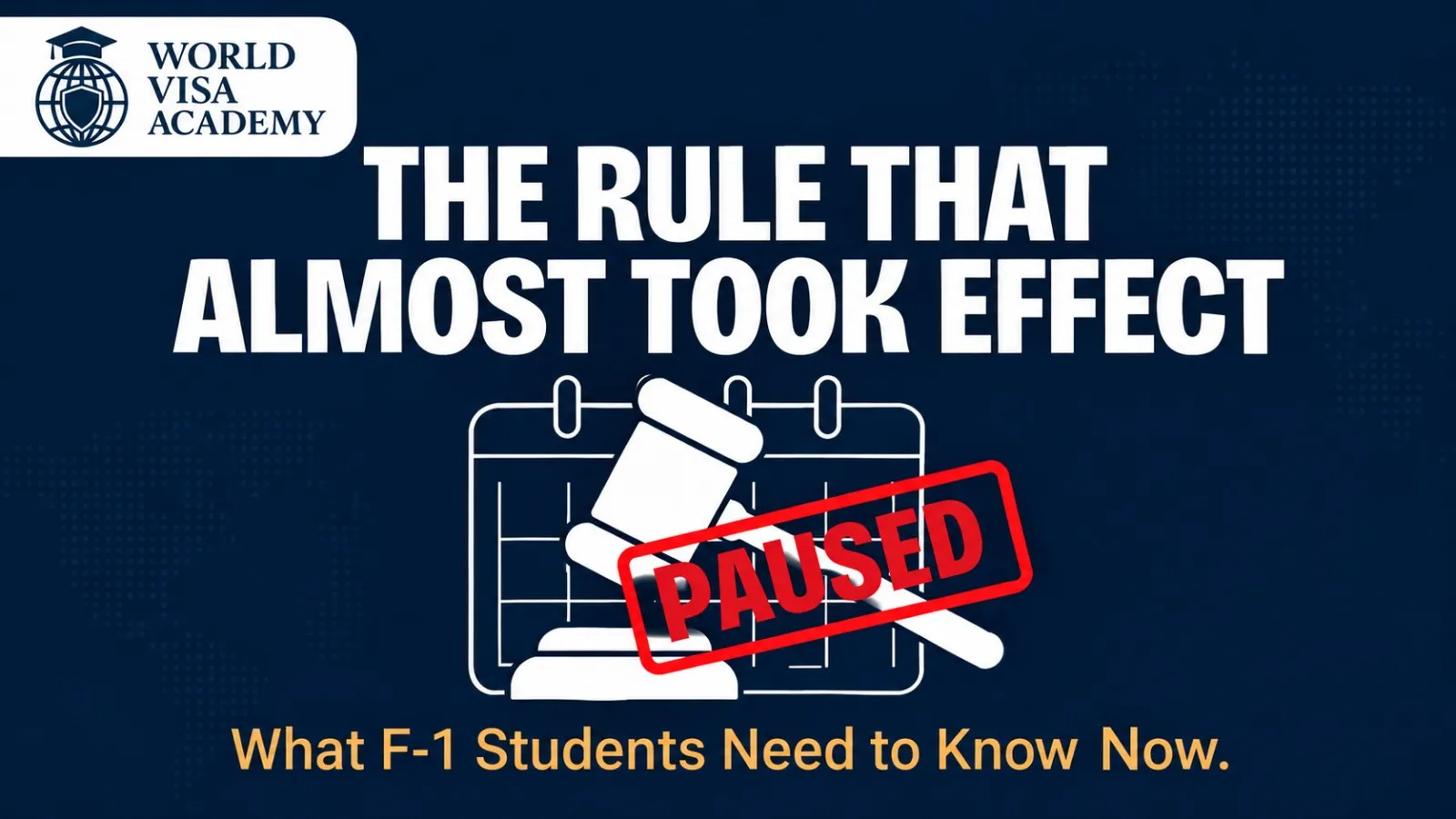
If you searched this topic expecting to read about a rule that already changed how long F-1 students can stay in the United States, here is the honest, current answer. It almost happened. It was scheduled to happen. Then, on the evening before it was due to take effect, a federal court stepped in and stopped it, at least for now.
This is genuinely one of the more dramatic regulatory stories in recent US student visa history, not because the rule itself disappeared, but because of just how close it came to reshaping the experience of over a million international students, Indian students very much included, before being paused at the last possible moment.
What Duration of Status Actually Meant
Since 1979, F-1 students admitted to the United States have generally been allowed to remain for as long as it took to complete their academic programme, provided they kept meeting their visa requirements. This was noted on their I-94 record simply as Duration of Status, or D/S, with no fixed expiration date attached. A student in a four year undergraduate degree, a five to eight year PhD, or a programme followed by Optional Practical Training and STEM OPT could generally continue studying and working without needing to apply for an extension every time their programme ran longer than expected.
This flexibility mattered enormously for research heavy fields, where PhD timelines regularly stretch well past four years, and for the many students who move directly from their degree into OPT or STEM OPT as a bridge toward employer sponsored status.
[INTERNAL LINK: OPT and STEM OPT explained for international students]
What the Blocked Rule Would Have Changed
On July 17, 2026, the Department of Homeland Security published a final rule ending Duration of Status entirely for F-1 students, J-1 exchange visitors and I visa media representatives. In its place, DHS proposed a fixed period of admission called an Admit Until Date, tied to the programme end date listed on a student's Form I-20, but capped at a maximum of four years regardless of how long the actual programme took.
Anyone needing more time, PhD candidates in particular, along with students pursuing OPT or STEM OPT beyond that four year window, would have needed to file Form I-539 with USCIS, pay filing fees, submit biometrics, and demonstrate continued eligibility, with USCIS holding full discretion to approve or deny each request. The post completion grace period, the window students get after finishing their programme to prepare for departure, transfer schools or change status, would also have shrunk from 60 days down to 30. I visa holders, foreign media representatives, would have faced an even tighter cap of just 240 days.
DHS framed the change as a way to strengthen oversight and properly screen and monitor international students, moving practical decision making about extensions from university staff back to federal immigration authorities directly.
The Injunction: What Actually Happened on September 14
Here is where the story takes its sharpest turn. On August 18, 2026, a coalition of higher education and labour organisations, including NAFSA, the Presidents' Alliance on Higher Education and Immigration, several university associations, and multiple labour unions, filed a lawsuit and a motion for a preliminary injunction in the US District Court for the District of Massachusetts, arguing the rule violated the Administrative Procedure Act.
The case moved fast. A hearing was held on September 3, 2026, in front of District Judge F. Dennis Saylor IV. Then, at the end of the day on Monday, September 14, 2026, just hours before the rule was due to take effect, Judge Saylor issued a nationwide preliminary injunction, blocking DHS from implementing or enforcing the rule while the underlying litigation continues. The court concluded the plaintiffs were likely to succeed in showing the rule was arbitrary and capricious, and that letting it proceed would cause immediate, irreparable harm.
Crucially, the judge applied this injunction nationwide, not just to the specific organisations that filed the case, citing the sheer impracticality of universities and students across the country operating under two different regulatory frameworks depending on where a lawsuit happened to be filed. The result: the rule did not take effect on September 15 as scheduled. Duration of Status remains fully in place, nationwide, until further notice, pending the outcome of the court case. The federal government is expected to appeal, though as of the most recent update, no appeal had yet been confirmed as filed.
Why Indian Students Specifically Were Watching This Closely
This rule was never going to affect every international student equally, and Indian students sit squarely in the group that stood to lose the most. India has become one of the largest, if not the largest, source countries for new international enrolment in the United States in recent years, and Indian students are disproportionately represented in STEM fields, exactly the disciplines where PhD programmes commonly run past the four year mark and where OPT and STEM OPT participation, often used as a bridge toward eventual H-1B sponsorship, is heaviest.
For a typical Indian PhD candidate in engineering or the sciences, a programme running six to eight years would have meant filing at least one, and likely more, discretionary extension applications with USCIS just to legally remain in the country and finish their degree, with no guarantee of approval. For master's students planning to use STEM OPT's full three year window after graduation, the shortened grace period and added extension filing requirement would have introduced real risk into a pathway many already treat as a critical step toward long term US employment.
What This Means for Indian Students and Families Right Now
The practical, current answer is reassuring, but it comes with an important caveat. Students currently in the US on F-1 status continue to be admitted and remain under Duration of Status exactly as before. No one needs to file an Extension of Stay application right now solely because of this rule, and no one's I-94 record has changed as a result of the injunction.
The caveat is that this is a pause, not a permanent resolution. The underlying case is still active, an appeal is widely expected, and the rule itself has not been struck down, only its implementation delayed while the court reviews the merits of the challenge. Anyone planning a multi year US study path, particularly a PhD, should treat this as an actively evolving situation rather than a settled one.
What Could Happen Next
Three realistic paths lie ahead. The government could appeal the injunction, and a higher court could eventually allow the rule to proceed, in which case the same four year cap and extension requirements described above would apply, likely with a new effective date. The litigation could continue at the district court level and result in the rule being struck down more permanently. Or DHS could revise the rule in response to the court's concerns and attempt to reissue it in a modified form. None of these outcomes is guaranteed, and the honest, responsible advice right now is to monitor developments closely rather than assume either the rule or its cancellation is final.
Before vs Proposed vs Current Status
| Feature | Original Duration of Status | Blocked Rule (Would Have Applied) | Current Status (As of Now) |
|---|---|---|---|
| Admission period | Until programme completion | Fixed date, max 4 years | Duration of Status, unchanged |
| Extension needed for longer programmes | No | Yes, via Form I-539 to USCIS | No |
| Post completion grace period | 60 days | 30 days | 60 days |
| I visa (media) admission | Duration of status | Max 240 days | Duration of status |
| Legal status of the rule | N/A | Published, enjoined before taking effect | Blocked nationwide, litigation ongoing |
Quick Checklist for Students and Consultants Right Now
The Bigger Lesson Here
This is a genuinely useful case study in why "final rule" does not always mean final. A rule can be published, scheduled, and just hours from taking effect, and still be paused by a single court order. For anyone advising Indian students on long term US study plans, the responsible message right now is neither alarm nor false reassurance, it is accurate, current status, paired with a clear understanding that this particular story is not over yet.
World Visa Academy's US study visa training tracks live regulatory changes and litigation like this, so you can give Indian students accurate, current guidance, not outdated headlines.
Explore WVA CoursesNo, not currently. The rule ending Duration of Status was scheduled to take effect on September 15, 2026, but a federal court in Massachusetts issued a nationwide preliminary injunction on September 14, 2026, blocking its implementation. Duration of Status remains fully in effect for F-1 students nationwide while the litigation continues.
It would have replaced Duration of Status with a fixed admission period, capped at a maximum of four years, tied to the programme end date on a student's Form I-20. Anyone needing more time, including most PhD candidates and students using OPT or STEM OPT beyond that window, would have needed to file a discretionary Extension of Stay application with USCIS, and the post completion grace period would have shortened from 60 to 30 days.
India is one of the largest source countries for international students in the US, with a particularly strong concentration in STEM fields, where PhD programmes commonly exceed four years and OPT or STEM OPT participation is especially high. Indian students in these categories would have faced the most frequent and consequential extension filing requirements under the blocked rule.
No. The September 14, 2026 court order is a preliminary injunction, meaning implementation is paused while the underlying lawsuit continues, not a final ruling striking the rule down. The federal government is expected to appeal, and the rule could still take effect later in its current or a revised form, depending on how the litigation unfolds.
No immediate action is required. Students currently in the US on F-1 status continue to be admitted under Duration of Status exactly as before the rule was published, and no Extension of Stay filing is needed solely because of this rule at this time. Students should stay informed as the litigation progresses, since the situation remains actively unresolved.







0 Comments
Be the first to comment.