Ceuta Migrant Crisis 2026: Why Tens of Thousands Crossed From Morocco Into Spain, and How Europe Is Reacting
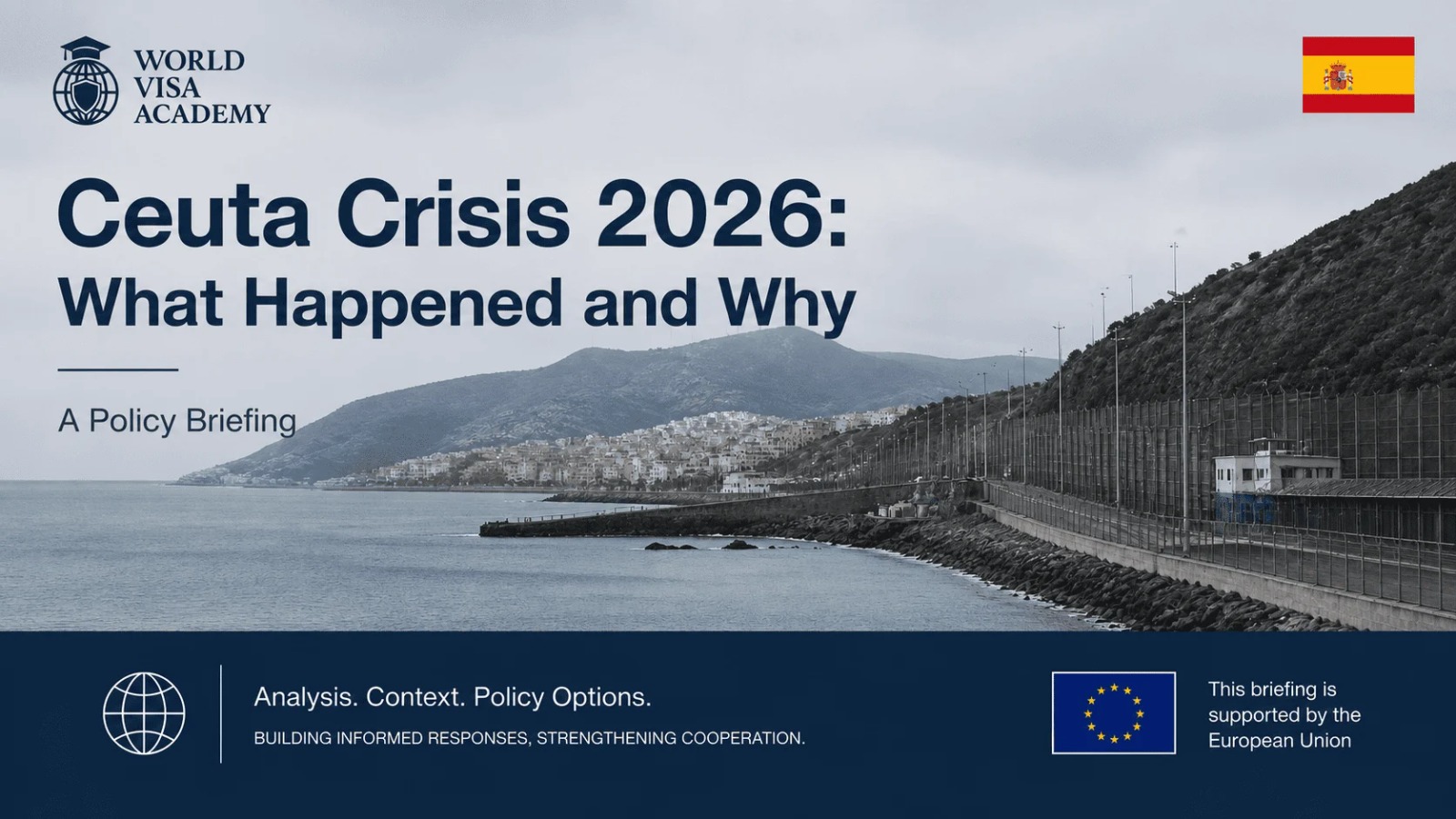

Between 50,000 and 60,000 people crossed from Morocco into Spain's North African enclave of Ceuta on 30 and 31 July 2026, in one of the largest single border crossing events Europe has seen in years. Spain's Interior Ministry told NBC News that around 50,000 people entered on Thursday alone, while several other outlets, including Global News, reported figures closer to 60,000. At least 57 bodies had been recovered on the Spanish side by Friday, according to the Spanish government's representative in Ceuta, with officials warning that the final toll could rise further once the situation on the Moroccan side is fully accounted for.
This blog explains what happened, why it happened now, what European governments have done in response, and what it could mean for travellers, visa applicants, and the wider Schengen system in the months ahead.
Where Is Ceuta and Why Does It Matter
Ceuta is a small Spanish city of around 85,000 people, sitting on the North African coast and bordered entirely by Morocco. Together with its sister city Melilla, Ceuta forms the only land border between the European Union and Africa. Because both cities sit inside the Schengen area, what happens at their fences and beaches has consequences that reach far beyond Spain, even though Morocco disputes Spanish sovereignty over both territories and considers them occupied land.
For decades, Ceuta and Melilla have periodically seen mass crossing attempts, most notably in May 2021 when around 10,000 people entered within days, following a diplomatic dispute between Madrid and Rabat. The July 2026 crisis is the largest such episode since then, both in scale and in its diplomatic fallout.
The Trend Before the Crisis: A Route Already Shifting
The sudden surge did not appear out of nowhere. Spain's overall irregular migration numbers had already been rising for several years. According to Spain's Interior Ministry, a record 63,970 people entered Spanish territory irregularly in 2024, up from around 56,000 in 2023 and nearly matching the historic peak of 2018. Most of that 2024 total, 46,843 people, arrived through the dangerous Atlantic route to the Canary Islands.
Through 2025 and into 2026, however, Spain signed new cooperation agreements with West African countries such as Mauritania and Senegal to intercept migrant boats before they departed. This sharply reduced Canary Islands arrivals but appears to have pushed movement toward other entry points instead.
| Route | 2024 total | Early 2026 trend | Change |
|---|---|---|---|
| Canary Islands (from West Africa) | 46,843 arrivals (record year) | 1,640 arrivals, January to March 2026 | Down about 82 percent year on year |
| Ceuta (from Morocco) | Over 2,500 arrivals, more than double 2023 | 2,826 arrivals, January to 15 July 2026 | Up about 149 percent year on year |
| Balearic Islands | Nearly 14,500 arrivals nationwide via Mediterranean routes | 1,179 arrivals, comparable period 2026 | Slight increase over 2025 |
By mid July 2026, in other words, Ceuta was already Spain's fastest growing entry point, even before the events of 30 and 31 July.
The Legal Trigger Behind the Sudden Surge
The immediate cause of the crisis was a court ruling, not a policy announced by any government. For years, Spain's Guardia Civil applied a practice known as "hot returns," or devoluciones en caliente, where migrants intercepted swimming toward Ceuta or Melilla were sent straight back to Morocco with no identification, no legal counsel, and no chance to request asylum. This applied specifically to people intercepted at sea, distinct from those who climbed the land fences.
On 29 June 2026, Spain's Supreme Court ruled, in Judgment 814/2026, that this summary return procedure could not legally be extended to people intercepted while swimming, since Spanish law only permits it for those crossing physical barriers such as fences. The ruling became public on 8 July 2026. Civil Guard officers reportedly warned at the time that removing this practical deterrent could encourage more sea crossing attempts during the summer months, since the water route offered a real chance of remaining in Spain long enough to trigger formal legal process.
Spain's Interior Ministry has said that migrant smuggling networks appear to have used the ruling to actively encourage crossings. Some analysts have also pointed to the long running dispute between Spain and Morocco over sovereignty of Ceuta and Melilla, noting that Moroccan forces did comparatively little to prevent the initial rush, though Morocco's government has not offered a detailed public explanation for its response on the day.
How the Crisis Unfolded
The Human Cost
The human toll of the crisis has been severe. Early reports on Thursday cited at least 9 deaths, rising to at least 18 by Friday morning, and Spain's government representative in Ceuta later said 57 bodies had been recovered on the Spanish side, with the possibility of additional deaths not yet confirmed on the Moroccan side. Officials and aid workers said many people drowned attempting to swim around the breakwater, while others died in the crush of the crossing itself. Ceuta's shelters for unaccompanied minors, which normally operate under strict capacity limits, were reported to be running far beyond their designed capacity even before the 30 July surge.
This remains a developing and sensitive situation, and figures are likely to be revised as Spanish and Moroccan authorities complete their accounting.
Spain's Response
Prime Minister Pedro Sánchez cut short other commitments to travel to Ceuta on Friday, where he was met by protesters. He described the crossing as a violation of Spain's territorial sovereignty and blamed human smuggling networks for organising it. Spain's government said it would try to expel those who entered illegally as quickly as possible, working in close coordination with Morocco, despite the very Supreme Court ruling that had limited automatic sea returns. Madrid and Rabat also announced a joint agreement to speed up formal returns of those who lack any legal basis to remain.
How Other European Countries and the EU Reacted
The scale of the crossing sent immediate ripples across the Schengen area, since Ceuta and Melilla, while subject to some special border check provisions, remain part of the same passport free travel system as the rest of the EU.
| Country or Institution | Response |
|---|---|
| Spain | PM Sánchez visited Ceuta, called the crossing a sovereignty violation, and accelerated returns to Morocco in coordination with Moroccan authorities |
| Italy | Temporarily suspended some Schengen air and sea travel checks with Spain for around 30 days, a decision Interior Minister Piantedosi based on national security assessments, and PM Meloni defended as necessary for public safety |
| France | President Macron ordered strengthened checks along the French Spanish land border, and Interior Minister Laurent Nuñez instructed officials to immediately step up border checks |
| European Commission | President Ursula von der Leyen said the EU cannot allow anyone to enter without following the bloc's rules, while Home Affairs Commissioner Magnus Brunner clarified that special Schengen provisions already apply to Ceuta and Melilla, and that there was no evidence of movement toward mainland Europe |
| Far right parties across Europe | Parties including France's National Rally and Germany's AfD publicly welcomed Italy's move, while critics called it a largely symbolic gesture aimed at domestic politics ahead of upcoming elections |
Spain's government pushed back on Italy's decision, arguing that European solidarity should not be optional in a genuine humanitarian emergency. The disagreement highlights a pattern that has repeated across several recent European migration episodes, where border countries under pressure ask for EU wide support, while other member states respond with stricter national controls instead.
The Bigger Picture: A New EU Migration System Arrives at the Same Time
The timing of the Ceuta crisis is notable because it comes right as the EU's new Pact on Migration and Asylum is entering into force. Adopted in 2024 after years of negotiation, the Pact formally begins applying from 12 June 2026, introducing common EU wide rules on asylum screening, border procedures, and a mandatory solidarity mechanism between member states.
The European Commission has already identified Spain, alongside Greece, Cyprus, and Italy, as being under significant migratory pressure, making it eligible for support from the Pact's 2026 solidarity pool, which totals 21,000 relocations or an equivalent 420 million euros in financial contributions from other member states. Whether the Ceuta crisis accelerates or complicates this rollout is something EU officials are likely to be watching closely in the coming weeks.
[INTERNAL LINK: WVA course on Schengen visa and EU immigration policy fundamentals]
What This Means for Travel Agents and Aspiring Visa Consultants
For travel professionals and those training to become visa consultants, episodes like this carry practical lessons that go beyond the headlines.
Checklist for travel professionals right now:
Understanding the legal and political forces behind stories like the Ceuta crisis, not just the headline numbers, is part of what separates a well trained visa consultant from someone simply reading the news. At World Visa Academy, this kind of real world policy literacy is built directly into our IAF accredited training programs, alongside the practical, country specific visa knowledge our students need.
What Happens Next
Several things are worth watching in the coming weeks. Italy's Schengen suspension with Spain is described as temporary, around 30 days, so its renewal or removal will be an early signal of how seriously EU institutions treat the episode. Spain and Morocco's joint agreement to speed up returns will also be tested by how many people are actually repatriated versus how many remain in Spain pending asylum claims. Finally, as the EU's new Migration Pact becomes fully operational from June 2026 onward, this crisis may become a real world test case for how the bloc's new solidarity and border procedure rules function under pressure.
This is an evolving story, and readers are encouraged to follow updates directly from Spain's Ministry of Interior, the European Commission, and established international news agencies for the latest verified figures.
Build real, career ready expertise in immigration law, visa processing, and international policy with World Visa Academy's IAF accredited training programs.
Explore WVA CoursesYes. Ceuta, along with Melilla, is Spanish territory and part of both the European Union and the Schengen passport free travel area. However, both cities already operate under special Schengen border check provisions because they form the EU's only land border with Africa, meaning some checks apply there that would not normally apply between other Schengen countries.
There is no indication of that so far. The European Commission has stated there is no evidence of movement from Ceuta toward mainland Europe, and the added checks introduced by Italy and France are described as temporary security measures rather than changes to visa policy. That said, immigration policy in Europe evolves quickly, and travel professionals should monitor official EU and national government sources for any formal changes.
Spain's Supreme Court ruled in June 2026 that migrants intercepted swimming toward Ceuta or Melilla could no longer be returned to Morocco immediately without formal legal process, a practice previously used as a deterrent. Spain's Interior Ministry has said smuggling networks appeared to exploit this legal change to encourage a large coordinated crossing attempt, on top of an already rising trend of arrivals through Ceuta earlier in the year.
Spanish authorities said they are working with Morocco to accelerate formal returns for those without a legal basis to remain, while reports indicate that a large share of those who crossed had already returned to Morocco within a day or two, either through organised repatriation or on their own due to a lack of shelter and food in the overwhelmed city. Those who do have grounds to seek asylum are entitled to formal legal process under Spanish and EU law.
It is too early to say with certainty, but the timing is significant. The EU's new Pact on Migration and Asylum, which introduces common asylum and border procedures along with a mandatory solidarity mechanism between member states, only began applying from 12 June 2026. Spain has already been identified by the European Commission as a country under migratory pressure eligible for EU solidarity support, and how this crisis is handled could influence how the Pact's new rules are applied in practice going forward.










0 Comments
Be the first to comment.