Canada Just Raised Express Entry Scores Again: What It Means for 2026 Applicants
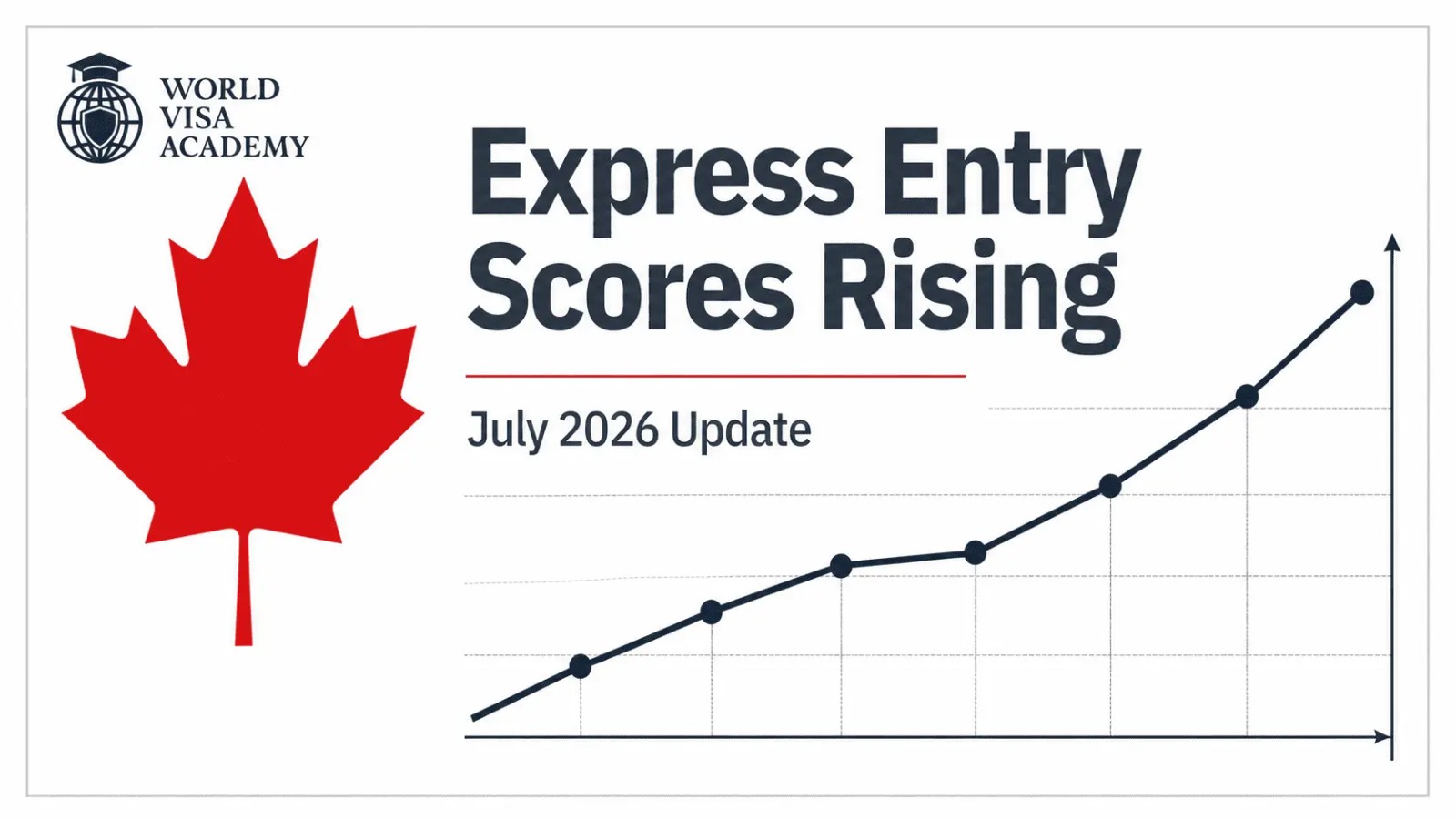

If you have been watching your Express Entry profile and wondering why your score suddenly does not feel good enough anymore, you are not imagining things. In July 2026, Canada's Express Entry cutoffs moved again, and one jump in particular caught a lot of attention.
On July 6, the Provincial Nominee Program draw invited candidates at a cutoff of 708, the lowest PNP score seen all year. Just two weeks later, on July 20, that same category jumped to 744. That is a rise of 36 points in a single round, and it is the story behind this article.
Here is what actually happened, why it happened, and what it means if you are still sitting in the pool.
The Draw That Got Everyone Talking
On July 20, 2026, Immigration, Refugees and Citizenship Canada, known as IRCC, issued 511 invitations to apply through a Provincial Nominee Program round. The minimum CRS score required was 744.
For context, a provincial nomination alone adds 600 points to a candidate's Comprehensive Ranking System score, known as CRS. So a cutoff of 744 usually means the candidate had a nomination plus a fairly strong base profile in language ability, education, and work experience.
What made this round notable was the jump from the previous PNP draw. Two weeks earlier, the July 6 round had cleared at just 708, the lowest PNP cutoff recorded so far in 2026. The 36 point swing between those two rounds shows how quickly things can move when a fresh batch of nominated candidates enters the pool.
Full July 2026 Draw by Draw Breakdown
Here is every Express Entry round held in July 2026, based on official IRCC results as reported through July 23.
| Date | Draw Type | Invitations Issued | CRS Cutoff |
|---|---|---|---|
| July 6 | Provincial Nominee Program | 534 | 708 |
| July 7 | Canadian Experience Class | 2,000 | 517 |
| July 9 | French Language Proficiency | 5,000 | 420 |
| July 10 | Senior Managers (2nd round) | 500 | 392 |
| July 20 | Provincial Nominee Program | 511 | 744 |
| July 21 | Canadian Experience Class | 2,000 | 516 |
| July 22 | French Language Proficiency | 5,000 | 399 |
| July 23 | Skilled Military Recruits (first ever draw) | 4 | 368 |
Look closely and you will notice the picture is not simply "scores are rising everywhere." The Provincial Nominee Program jumped sharply. Canadian Experience Class barely moved, staying within a single point. French language proficiency actually dropped slightly, from 420 down to 399, making it more accessible, not less.
This is the real story of 2026. Scores are not moving as one block. They are moving differently depending on which door you are trying to walk through.
Why Canada Has Not Held a General Draw Since April 2024
Here is something that surprises a lot of applicants. IRCC has not held a general, all program Express Entry draw since April 23, 2024, when the cutoff was 529. That is now well over two years without the kind of draw that used to be the backbone of the whole system, one where every candidate in the pool competes on CRS score alone, regardless of category.
Instead, IRCC has leaned almost entirely on three types of rounds through 2025 and into 2026.
If you do not fall into one of these groups and you are relying purely on a strong human capital score, 2026 has been a genuinely difficult year to get an invitation. This is one of the most important things for applicants to understand right now, and it explains a lot of the frustration people are feeling online.
The Bigger Picture: Canada's 2026 to 2028 Immigration Levels Plan
The shift away from general draws is not random. It connects directly to Canada's 2026 to 2028 Immigration Levels Plan, which sets the government's targets for permanent and temporary residents over the next three years.
A few numbers from that plan explain a lot of what is happening inside Express Entry right now.
Put simply, Canada wants to keep permanent immigration steady while pulling back hard on new temporary arrivals, and it wants to prioritise people who are already in the country over people applying from abroad. That is a big part of why Canadian Experience Class draws have stayed active and frequent all year, while general draws have essentially disappeared.
[INTERNAL LINK: WVA guide to Canada PR pathways for international students]
New Categories Added in 2026
IRCC also expanded its list of category based selection groups this year, giving more specific groups of candidates a shot at lower cutoffs than the general pool would allow.
At the same time, the Agriculture and Agri Food occupations category was retired for 2026, and the STEM category has now gone more than 27 months without a dedicated draw. In total, ten categories remain active this year.
Where Candidates Actually Stand: The Pool Right Now
As of July 19, 2026, the Express Entry pool held 231,533 active candidates, down by 3,594 from just two weeks earlier. Here is how those candidates were spread across score ranges.
| CRS Score Range | Number of Candidates |
|---|---|
| 0 to 300 | 7,836 |
| 301 to 350 | 17,490 |
| 351 to 400 | 51,107 |
| 401 to 450 | 63,877 |
| 451 to 500 | 72,579 |
| 501 to 600 | 18,133 |
| 601 to 1,200 | 511 |
This table tells its own story. Nearly two thirds of the entire pool, nearly 188,000 people, sit below a score of 500. Only 511 candidates score above 600, and almost all of those hold a provincial nomination, which is exactly why PNP cutoffs sit in the 700s while nearly everyone else competes for the much smaller number of spots in category based and Canadian Experience Class rounds.
If your score sits in that crowded 401 to 500 band, you are in good company, but you are also in the most competitive part of the entire pool.
Why Scores Are Rising for Some Streams and Falling for Others
The pattern through 2026 comes down to draw size versus pool pressure, category by category.
Canadian Experience Class has stayed remarkably steady, moving only within the 507 to 518 range across the entire year. When IRCC issues larger batches of invitations, the cutoff dips slightly. When batches shrink, as they did between the June 23 round of 4,000 invitations and the July 7 round of just 2,000, the cutoff creeps up by a point or two. It is less about growing competition and more about how many invitations go out in each round.
Provincial Nominee Program draws behave very differently, since a nomination adds 600 points on top of a candidate's base score. When a large batch of newly nominated candidates enters the pool at once, cutoffs can swing sharply from one round to the next, exactly what happened between July 6 and July 20.
French language proficiency draws have actually become slightly more accessible in recent weeks, dropping from 420 to 399 between July 9 and July 22, even as thousands of invitations continue to go out. This remains the single most realistic route for candidates without Canadian work experience or a provincial nomination.
What This Means for 2026 Applicants
If you are actively building or maintaining an Express Entry profile this year, here is how to think about your situation.
How to Improve Your CRS Score
Regardless of which category fits your profile, these remain the most reliable ways to strengthen your score.
What to Watch for Through the Rest of 2026
IRCC has moved to what many immigration analysts describe as a cluster pattern, holding several draws close together, then pausing for weeks at a time, rather than the steady every two week rhythm seen in earlier years. Expect this pattern to continue, along with continued heavy reliance on Canadian Experience Class, French language, and category based rounds rather than a return to general draws in the near term.
For travel and immigration professionals, this is exactly the kind of shifting landscape where structured, current training makes the difference between guessing and actually guiding a client well. At World Visa Academy, our Canada immigration modules are updated to reflect exactly these kinds of policy shifts, so consultants can explain to clients not just what the cutoff is today, but why it moved and what it likely means for their specific profile.
[INTERNAL LINK: WVA Canada Express Entry consultant training module]
[INTERNAL LINK: WVA guide to Provincial Nominee Program applications]
Express Entry has always rewarded candidates who understand the system rather than just the headline number. In a year where the headline number keeps moving in different directions depending on the category, that understanding matters more than ever.
Express Entry policy shifts constantly, and clients rely on consultants who can explain exactly why. Build that expertise through WVA's IAF accredited Canada immigration training programs.
Explore WVA CoursesThe jump was specific to the Provincial Nominee Program category, which rose from a cutoff of 708 on July 6 to 744 on July 20, a rise of 36 points. This happened because a fresh batch of candidates with provincial nominations, which add 600 points to a CRS score, entered the pool between those two rounds. Other categories like Canadian Experience Class stayed nearly flat during the same period.
No. Canada has not held a general, all program Express Entry draw since April 23, 2024, when the cutoff was 529. Since then, IRCC has relied almost entirely on Canadian Experience Class, category based, and Provincial Nominee Program draws, which means candidates without Canadian work experience, a strong category match, or a provincial nomination currently have the least predictable path to an invitation.
French language proficiency draws have offered the lowest cutoffs of any major stream through mid 2026, dropping as low as 399 in the July 22 round. Candidates with strong French test results, even alongside English, currently have one of the most accessible routes into the pool of invited candidates, well below Canadian Experience Class and far below Provincial Nominee Program cutoffs.
A provincial nomination adds 600 points directly to your Comprehensive Ranking System score, which is why Provincial Nominee Program draw cutoffs typically sit between 700 and 800, far above every other category. For most candidates without an exceptionally strong base profile, securing a provincial nomination is the single most effective way to guarantee an invitation within one or two draws.
A score around 450 currently places you in the most crowded part of the pool, where over 72,000 candidates sit in the 451 to 500 range as of July 2026. It is still worth entering, since your profile remains active for 12 months and you can improve your score over that time through better language results, additional work experience, or a provincial nomination, all of which can move you into range for an invitation.









0 Comments
Be the first to comment.