Trump Administration Suspends PERM Processing for Major Tech Companies: What Indian H-1B Workers Need to Know
A major development in U.S. employment-based immigration could affect thousands of foreign technology professionals, including Indian IT workers currently working in the United States.
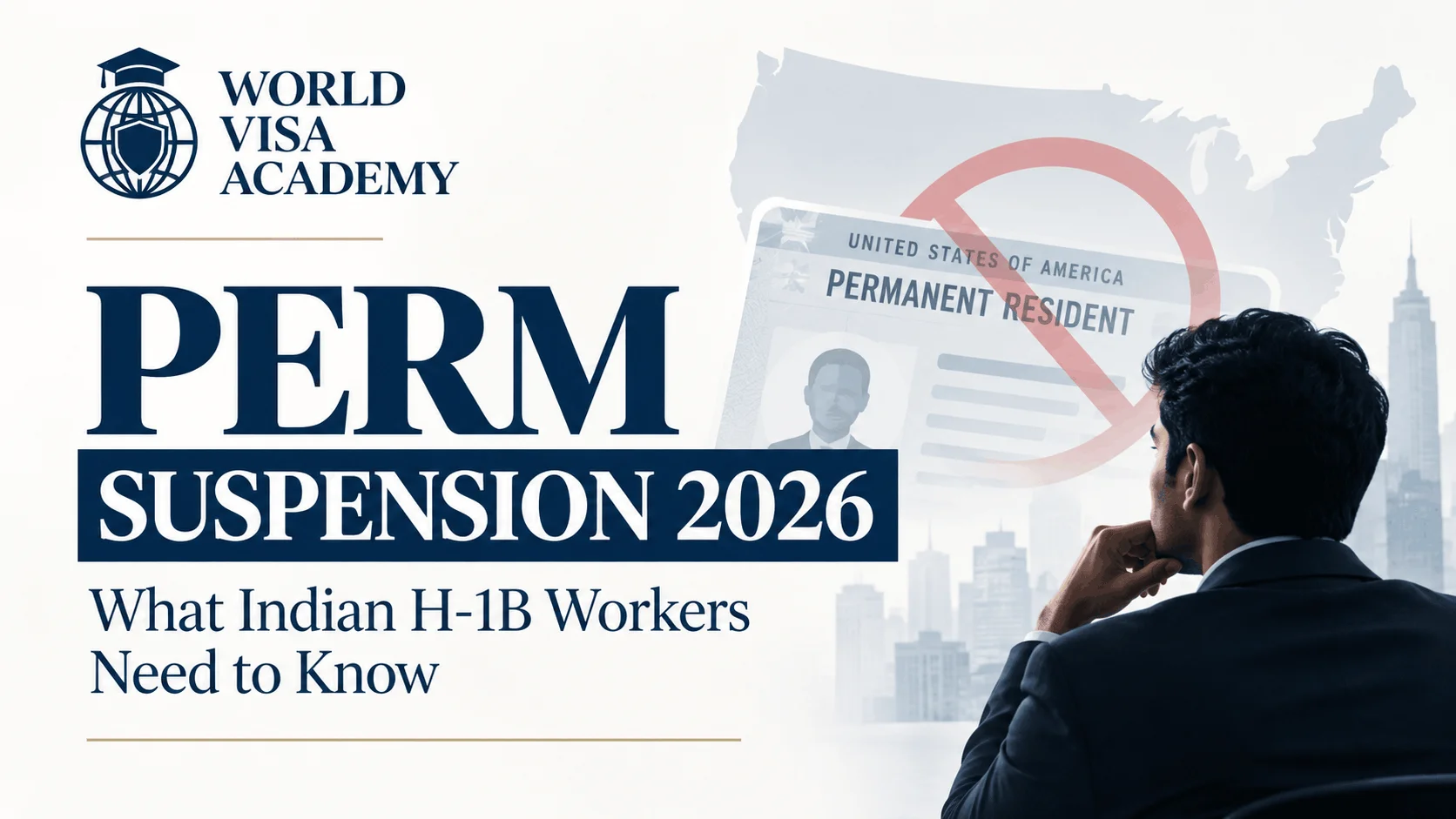
The Trump administration has suspended several major technology and IT companies from participating in the Permanent Labor Certification, commonly known as PERM, process.
According to reporting on October 8, 2026, companies named in the action include Microsoft, Adobe, Cognizant, Infosys, Tata Consultancy Services (TCS), Wipro, HCL Technologies and Capgemini. The reported restrictions mean that certain new PERM applications will not be accepted and pending PERM applications for affected employers will not be processed while the restrictions apply.
For Indian professionals working in the U.S., this is important because many Indian technology workers rely on employer-sponsored immigration pathways for long-term employment and permanent residence.
However, there is an important distinction:
This is not an H-1B visa ban.
It is also not a ban on Indian citizens getting U.S. green cards.
The immediate issue concerns the employer-sponsored PERM labor certification stage, which can be a critical part of the employment-based green card process.
On October 8, 2026, the U.S. government took action against several large technology and IT companies by restricting their participation in the PERM program.
The companies reported as being affected include:
Reuters reported that the government would not accept certain new PERM applications or process pending PERM applications for the affected companies.
The development is particularly significant for employees who are working in the United States on temporary work authorization and are depending on employer sponsorship to eventually obtain permanent residence.
At the same time, reporting indicates that companies such as Meta, Amazon and Alphabet/Google were not included in the reported restriction at that time.
PERM stands for Program Electronic Review Management.
It is the U.S. Department of Labor's system for processing applications for Permanent Labor Certification.
In many employer-sponsored employment-based green card cases, PERM is one of the first major steps.
The purpose is broadly to establish that:
The employer generally completes the required recruitment process and submits Form ETA-9089, Application for Permanent Employment Certification, to the Department of Labor.
If the PERM application is certified, the employer can generally move forward with the next stage of the employment-based immigration process.
This is where the current development becomes particularly important for Indian professionals.
Many Indian technology professionals in the United States work on H-1B status.
For some of these workers, their employer may eventually sponsor them for permanent residence.
A simplified employment-based green card pathway can look like:
The final stage can involve adjustment of status in the United States or consular processing, depending on the individual's circumstances and visa availability.
Therefore, a disruption at the PERM stage can potentially delay the entire permanent-residence timeline.
This is especially important for Indian nationals because employment-based immigration can involve lengthy waits depending on the category and visa availability.
No.
This is perhaps the most important clarification for Indian IT professionals.
PERM and H-1B are separate immigration processes.
The H-1B program allows eligible foreign professionals to work temporarily in the United States in qualifying specialty occupations.
PERM is a labor-certification process used in many employer-sponsored permanent-residence cases.
Therefore, the current PERM action does not automatically terminate the H-1B status of employees working for the affected companies.
Reporting from The Washington Post/AP also indicated that the suspension does not prohibit the affected companies from employing H-1B workers.
An Indian professional who is currently maintaining valid H-1B status should therefore not interpret this news as an instruction to leave the United States.
The individual's immigration status must instead be evaluated based on their own H-1B validity and case history.
The reported action comes amid a much broader U.S. government crackdown on alleged abuse of foreign-worker immigration programs.
Government officials have raised concerns that some employers may use foreign-worker programs to:
The administration has particularly increased scrutiny of the H-1B and PERM systems.
However, Indian professionals and employers should be careful about interpreting these allegations.
The fact that a company has been named in the suspension does not mean that the company has been proven guilty of fraud.
For example, reporting from The Washington Post/AP noted that officials did not publicly provide evidence that Microsoft had replaced U.S. workers with H-1B employees as alleged. It also reported that the reasons for some individual company investigations were not fully clear.
Therefore, allegations should remain allegations unless and until specific findings are established.
The current PERM development is not happening in isolation.
In July 2026, the U.S. Department of Labor's Office of Inspector General announced increased enforcement against fraud and other abuses involving the H-1B and PERM systems.
The agency said investigations had uncovered alleged schemes involving fraudulent applications, wage kickbacks and below-wage labor arrangements.
The OIG also encouraged workers to report suspected violations involving:
This indicates that employers using foreign-worker programs are operating in an increasingly strict compliance environment.
The impact will not be identical for every Indian H-1B worker.
It depends largely on the stage of the individual's employment-based green card process.
If an Indian professional is currently working on H-1B status but the employer has not started the PERM process, the suspension could make it more difficult for the employer to begin the green card process during the restriction.
If the employer is currently conducting recruitment or preparing the PERM filing, the company may need to reassess how the suspension affects the case.
Workers with pending PERM applications could potentially experience a direct delay because the reported restriction prevents processing of certain pending applications for affected employers.
A worker whose PERM has already been certified is at a more advanced stage.
The impact may therefore be different from someone whose PERM application has not yet been filed.
If the employee has already moved beyond PERM and has an I-140 petition pending or approved, the situation is different again.
The PERM suspension does not automatically erase a completed PERM or an approved I-140.
However, individual circumstances still matter.
This is an especially important issue.
Generally, H-1B status is subject to a six-year maximum period, although U.S. immigration law provides certain exceptions and extensions.
Under AC21 provisions, certain H-1B workers can potentially qualify for extensions beyond the normal six-year limit when their employment-based green card process meets specific requirements.
For example, certain cases involving a labor certification or immigrant petition that has been pending for at least 365 days can potentially qualify for an extension.
Other rules can apply when an I-140 has been approved but an immigrant visa number is unavailable.
This means an Indian H-1B worker approaching the six-year limit should not simply assume:
“PERM is suspended, so I have to leave America.”
But they should also not assume:
“I automatically qualify for another H-1B extension.”
The answer depends on the worker's specific immigration history.
Indian nationals represent a significant portion of the U.S. skilled-worker immigration ecosystem, particularly in technology and IT services.
Many Indian professionals work for multinational companies that regularly sponsor H-1B workers and employment-based green cards.
Companies such as TCS, Infosys, Wipro, HCL Technologies and Cognizant have large Indian workforces and major U.S. operations.
Therefore, any significant change in the PERM process involving these employers deserves close attention from Indian professionals.
The biggest issue is not necessarily the loss of current employment.
It is the possibility of delays in the long-term permanent-residence pathway.
A simplified example can help explain the potential impact.
Suppose an Indian IT professional is working in the U.S. on H-1B status.
Their employer decides to sponsor them for an employment-based green card.
The general process may involve:
Step 1: Prevailing wage
↓
Step 2: Recruitment
↓
Step 3: PERM filing
↓
Step 4: PERM certification
↓
Step 5: I-140
↓
Step 6: Visa availability
↓
Step 7: I-485/Consular Processing
If PERM is delayed at Step 3, subsequent steps can also be delayed.
That does not necessarily mean the entire green card process is cancelled.
It means the employee may be unable to progress normally until the employer can proceed with the required immigration stage.
Do not rely only on your company's general immigration announcement.
Ask whether your individual case is:
The answer can materially change the impact.
If your H-1B validity is approaching its maximum period, review your immigration strategy early.
Do not wait until the final months to understand whether an extension may be available.
Ask your employer:
“How does the current PERM restriction affect my individual green card case?”
Also ask whether the company has received any communication from the Department of Labor or whether alternative immigration strategies are being considered.
If your I-140 has already been filed or approved, understand how your priority date and employment-based category affect your next step.
The situation of a worker with an approved I-140 can be very different from someone who has not yet started PERM.
Immigration cases are highly individual.
An Indian H-1B worker approaching the six-year limit, for example, may require a detailed review of their PERM filing date, I-140 status and other immigration history.
A qualified U.S. immigration attorney should be consulted for case-specific legal advice.
| Claim | What It Actually Means |
|---|---|
| “H-1B visas have been banned.” | Incorrect. The reported action concerns PERM processing. |
| “Indian citizens cannot get U.S. green cards.” | Incorrect. There is no India-specific green card ban in this announcement. |
| “All green card applications are cancelled.” | Incorrect. The restriction concerns certain PERM processing for affected employers. |
| “All employees of these companies must leave the U.S.” | Incorrect. Existing valid H-1B status is not automatically terminated. |
| “The named companies have been proven guilty of fraud.” | Not established. The government has cited allegations and investigations. |
| “Existing green card holders lose their green cards.” | No automatic cancellation. Existing permanent residents are in a different position. |
The situation could continue to develop.
The U.S. government may provide additional information about the investigations and restrictions.
Affected companies could potentially challenge government actions through legal channels.
The administration could also introduce additional changes to employment-based immigration programs.
For Indian professionals, this means that immigration planning should not be based on one headline alone.
The most important question is:
For Indian students and professionals planning a U.S. career, the latest development highlights an important lesson.
Getting a job in the United States and obtaining permanent residence are two different immigration objectives.
A person may obtain H-1B status and legally work in the United States while still having to navigate a separate and potentially lengthy employment-based green card process.
Before accepting a U.S. employment opportunity, professionals should understand:
For Indian IT professionals, employer immigration policies can therefore be an important factor when evaluating a U.S. job opportunity.
The PERM suspension is another indication that U.S. immigration policy is becoming increasingly focused on employer compliance, wages, recruitment practices and the use of foreign-worker programs.
The Department of Labor's enforcement activities and the administration's broader H-1B policies suggest that companies may face greater scrutiny when sponsoring foreign professionals.
For Indian workers, this does not mean the U.S. employment route has closed.
It means that immigration planning needs to become more strategic.
Professionals should understand both their temporary work status and their long-term permanent-residence pathway.
The reported October 8, 2026 PERM suspension involving major technology companies is a significant development for Indian IT professionals working in the United States.
Companies named include Microsoft, Adobe, Cognizant, Infosys, TCS, Wipro, HCL Technologies and Capgemini.
The action primarily affects the PERM stage of employment-based green card processing.
It does not automatically cancel H-1B status, and it does not create a blanket ban on Indian citizens obtaining U.S. permanent residence.
However, Indian H-1B workers whose green card cases are still dependent on PERM could potentially face delays.
Workers should therefore determine exactly where their case stands and understand how the current restriction could affect their immigration timeline.
For anyone approaching the H-1B six-year limit, the issue deserves particular attention because certain extensions beyond six years depend on specific employment-based immigration circumstances.
As U.S. immigration policy continues to evolve, Indian professionals should rely on official updates and qualified immigration advice rather than social-media headlines or generalized claims.
U.S. immigration policies can change quickly, especially for H-1B workers, employment-based green cards and international professionals. World Visa Academy provides practical visa and immigration training covering U.S. visa processes, documentation, case assessment and current immigration developments.
Explore U.S. Visa TrainingNo. The reported action concerns the PERM labor-certification process and does not automatically cancel valid H-1B status. Indian H-1B workers should separately check the validity of their current H-1B status and their employer's immigration sponsorship plans.
Among the companies named in reporting are Infosys, Tata Consultancy Services (TCS), Wipro and HCL Technologies, along with Microsoft, Adobe, Cognizant and Capgemini.
Not automatically. The main concern is for workers whose employment-based green card process still depends on PERM. The actual impact depends on whether PERM has been filed, certified, or completed and whether the case has progressed to the I-140 or later stages.
The worker should first confirm the status of the PERM case with the employer's immigration team and determine whether the case is covered by the current restriction. If the worker is approaching the H-1B six-year limit or has other time-sensitive immigration issues, professional legal advice should be obtained.
Yes. The current development does not constitute a blanket ban on green cards for Indians. Employment-based immigration remains available under applicable categories and rules, although processing, eligibility, visa availability and employer sponsorship can affect individual cases.








Would you like to read this article in Hindi?
0 Comments
Be the first to comment.