Top 10 Reasons Visas Get Refused, and How to Avoid Them
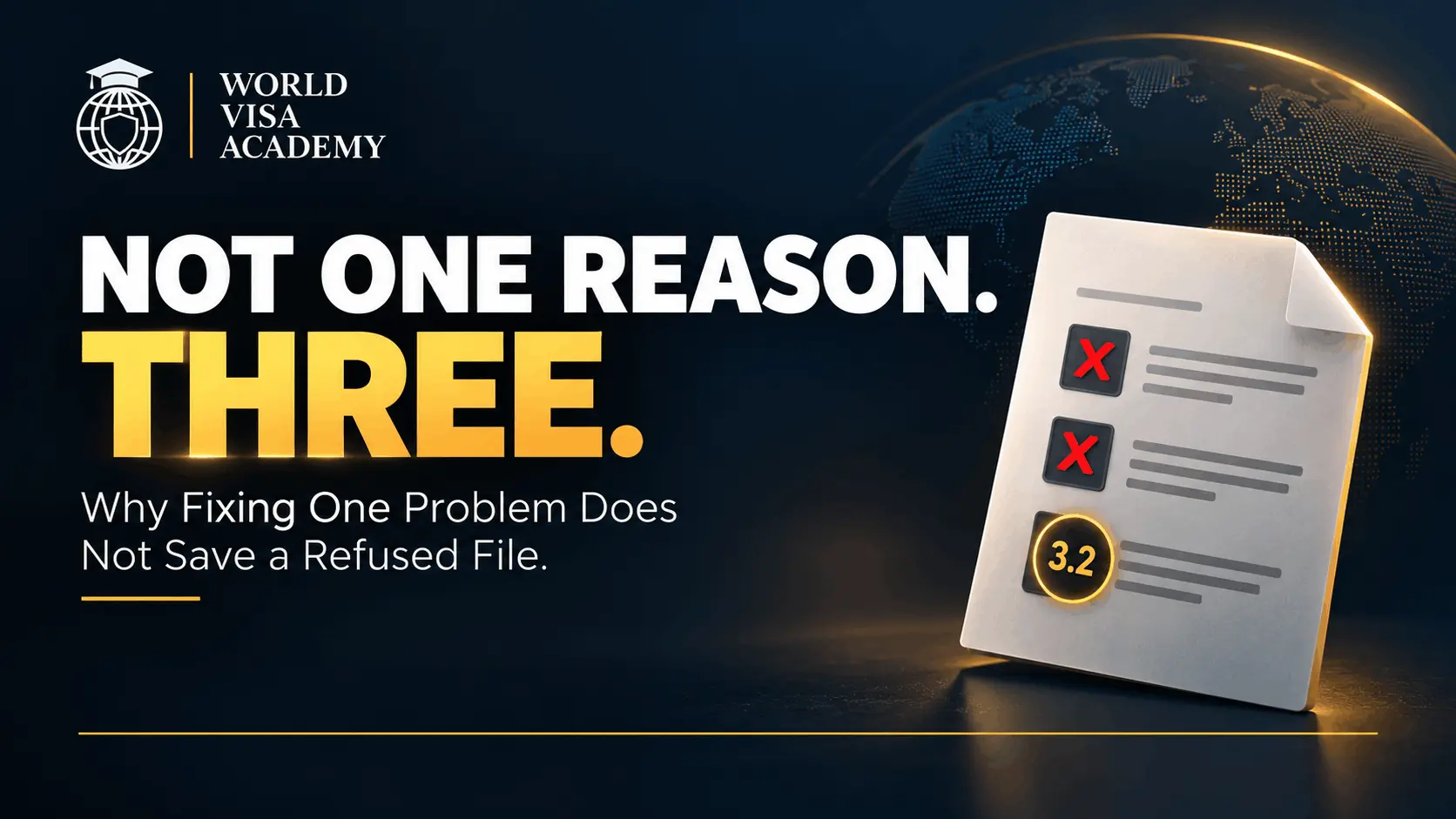

The second finding that changes how you read a refusal letter.
IRCC data shows refused Canadian study permit applications carried an average of three refusal reasons each in 2025, rising to 3.2 reasons per application between January and April 2026.
In 2025 and early 2026, the five most commonly cited grounds each factored into over 25 percent of all study permit refusal cases. Officers can select multiple reasons, and they heavily favoured that top five.
This is why so many reapplications fail. An applicant fixes the one reason that seemed most obvious and resubmits. The other two were still there.
| Destination | Refusal or Approval Rate | Period | Source |
|---|---|---|---|
| Canada study permits | 41 percent approval across all study levels | 2025 | IRCC via ApplyBoard |
| Canada study permits, sample | 49 percent refused | June 2026 | ApplyBoard analysis of 2,812 decisions |
| Canada refusals in one year | Nearly 160,000 applications | 2025 | IRCC via ApplyBoard |
| US F-1 student visas | 35 percent refused, a decade high | Recent | US State Department refusal rate tables |
| US F-1 for comparison | 15 percent refused | FY2014 | US State Department |
| UK Standard Visitor | Around 23 percent refused across over 2 million applications | Recent | UK Home Office |
| Australia student visas | Approximately 18 percent refused | 2024 | Published national statistics |
Rates vary enormously by nationality, and the spread is wider than most applicants realise.
| Nationality | Canada Study Permit Approval, Early 2026 | Source |
|---|---|---|
| India | 41 percent, up from 30 percent in full year 2025 | IRCC via ApplyBoard |
| Nigeria | One in four approved | IRCC via ApplyBoard |
| Ghana | 12 percent approved | IRCC via ApplyBoard |
UK sponsored study refusals in the year ending March 2026 ran at 16.7 percent for Ghana, 16.0 percent for Pakistan, 14.1 percent for Bangladesh and 10.3 percent for Nigeria, but spiked sharply in the Q4 2025 to Q1 2026 quarters, reaching 41 percent for Pakistan, 26 percent for Ghana and 20 percent for Nigeria.
This is genuinely useful and many applicants still do not know about it.
On 29 July 2025, IRCC introduced a transparency change: officer decision notes are now automatically included with refusal letters for temporary resident applications, including study permits.
Previously, applicants received a generic letter with ticked boxes and had to request GCMS notes separately to understand what the officer actually thought. Now that reasoning arrives with the refusal.
If you are refused by Canada after July 2025, read the officer notes carefully. They tell you what a reapplication must actually address.
The single most common refusal ground worldwide, appearing under different names in different systems.
In the US it is Section 214(b) of the Immigration and Nationality Act, which presumes every non immigrant applicant intends to immigrate until they demonstrate otherwise. It is the most common category of US non immigrant refusal, and there is no appeal.
In Canada, IRCC data confirms this was the most common study permit refusal reason in 2025 and early 2026. Among Nigerian students specifically, three of the five most commonly cited refusal grounds related to the officer's belief the applicant would not leave after graduation.
How to avoid it: document verifiable ties. Stable employment with a letter confirming your return, property ownership, ongoing business interests, family responsibilities, enrolment in something continuing at home. Vague statements of intent carry no weight. Verifiable commitments do.
The biggest preventable category, and worth separating into two distinct failures.
Failure one: not enough money. Canada's minimum proof of funds for most provinces is CAD 22,895 in living expenses for a single student plus first year tuition, rising to CAD 24,617 for Quebec since 1 January 2026.
Failure two, and far more common: enough money, presented badly. Among Nigerian, Indian and Ghanaian applicants in early 2026, each of the three most common financial refusal reasons was cited in roughly 33 percent of cases. ApplyBoard's analysis found applicants who likely had the money simply could not prove it in a way a visa officer could trust.
How to avoid it: show funds held over a sustained period, not deposited last week. Document the source of every significant sum. If a sponsor funds you, prove their income and your relationship. Even applicants holding a GIC and a tuition receipt get refused on financial grounds when the wider picture is unclear.
Note that Canada released stricter study permit financial assessment guidelines in July 2026, so this category is expected to weigh more heavily through the rest of the year.
Officers assess whether your course choice makes sense given your background. A commerce graduate with eight years in finance applying for a hospitality diploma will face questions. Not because either field is lesser, but because the logic is not self evident.
Published analysis indicates over 70 percent of Canadian study permit refusals cite purpose of visit in some form.
How to avoid it: explain the progression explicitly. Why this course, why this institution, why now, and how it connects to what you have already done and what you intend afterward. Make the officer's job easy.
An officer reading your file notices when your application form, bank statements, employment letter and statement of purpose tell slightly different stories.
A salary that does not match your bank inflows. Employment dates contradicting your CV. A stated purpose that does not match your itinerary.
How to avoid it: read every document together as one narrative before submitting. Every date, figure and claim should reconcile with every other.
The most preventable reason, and it includes one failure mode that is brutally unforgiving.
In Canada, a Provincial or Territorial Attestation Letter confirms a student counts under the cap. If the PAL or TAL expires before the government opens the file, the application is refused automatically. Nobody reads the rest of it.
How to avoid it: work from the current published checklist for your exact visa category and destination, and track the expiry date of every time limited document in the file.
Files including dependants face a significantly tougher review. The application must show more money and a clear plan for the whole family, not just the applicant.
This category is becoming more important as destinations restrict dependants. The UK barred most students from bringing dependants in 2024, and Australia announced a similar restriction in September 2026.
How to avoid it: budget and document for every family member separately, including schooling arrangements for children where applicable, and check whether your destination still permits dependants at all.
Some institutions carry weak compliance records. Some programmes attract heightened scrutiny because they have historically been used as migration routes rather than genuine study.
IRCC's own reasoning has cited programme credibility as a refusal factor.
How to avoid it: research your institution's standing and compliance record before applying, not after refusal.
This causes the most severe and longest lasting damage of anything on this list, and applicants underestimate it constantly.
Countries share visa refusal information. UK and US application forms ask directly whether you have been refused by any country. Schengen states can see previous applications and refusals across the area.
In Canada, misrepresentation results in immediate refusal and typically a five year ban from entering under any immigration category.
ApplyBoard's analysis made the point bluntly: most of these students would likely have been fine if they had simply disclosed it.
How to avoid it: declare every previous refusal honestly. A previous refusal is an obstacle you can argue past. A concealed one becomes a finding that closes the door for years.
Officers verify. Employment letters get called. Bank statements get cross checked. Invitation letters get examined against the inviting party's own immigration status.
How to avoid it: ensure every supporting document survives a phone call. If your employer will not confirm the letter they signed, that letter is a liability rather than an asset.
Applying for a tourist visa while your documents describe business meetings. Applying for a short course while your plan describes settlement.
For Schengen specifically, applying through the wrong country causes automatic problems. You must apply to the country of your main destination. Travelling on a visa issued by one country while spending the entire trip in another creates issues for future applications.
How to avoid it: choose the category that genuinely matches your purpose, then build the entire file around that one coherent purpose.
| # | Reason | Primary Fix |
|---|---|---|
| 1 | Not convinced you will leave | Document verifiable home country ties |
| 2 | Financial documentation | Sustained balance, documented source, clear sponsor evidence |
| 3 | Unclear study plan | Explain the logic of your progression explicitly |
| 4 | Internal inconsistencies | Reconcile every document before submitting |
| 5 | Incomplete or expired documents | Current checklist, track every expiry date |
| 6 | Dependants included | Document funds and plans for every family member |
| 7 | Institution or programme concerns | Research compliance record first |
| 8 | Undeclared previous refusals | Always declare, never conceal |
| 9 | Unverifiable documents | Ensure every document survives a check |
| 10 | Purpose mismatches category | Apply in the category that fits your actual purpose |
Visa fees are non refundable regardless of outcome. Current fees include approximately 90 euros for Schengen, 185 dollars for a US B1 or B2, around 127 pounds for a UK Standard Visitor and 100 Canadian dollars for a Canada visitor visa.
Beyond the fee, a refusal costs an intake or travel window, and becomes a fact you must declare on every future application worldwide.
| Destination | Appeal Route |
|---|---|
| United States, 214(b) | No appeal available, reapplication only |
| Canada | Judicial review at Federal Court, mostly for procedural errors |
| Schengen | Appeal available, with country specific deadlines |
| United Kingdom | Refusal letters cite specific paragraph references, making reasoning more transparent |
Knowing which route exists before you are refused should shape how you document the file from the start.
One warning worth stating plainly. If you have been refused twice on the same grounds without new evidence, a third identical application will not produce a different result.
Read your own file as if you were the officer who has eleven minutes to decide.
Every claim supported. Every document agreeing with every other. Every gap explained somewhere in the file rather than left for someone to notice.
Officers are not hunting for reasons to refuse. They are looking for enough to be confident. Nearly half of Canada's refused students in June 2026 failed not because they lacked funds, but because the file never gave the officer that confidence.
World Visa Academy's training uses real approval and refusal case studies from across 80+ countries, teaching the documentation standards working consultants rely on.
Explore WVA CoursesMore than most applicants expect. IRCC data shows refused Canadian study permit applications carried an average of three reasons in 2025, rising to 3.2 between January and April 2026. The five most cited grounds each appeared in over 25 percent of cases. This is why fixing one visible problem and reapplying often fails.
According to ApplyBoard's analysis of 2,812 Canadian study permit decisions in June 2026, lack of financial documentation was cited in 47 percent of the 1,370 refusals examined. ApplyBoard's CEO described most of these as avoidable, noting that many applicants likely had the money but could not prove it in a way an officer could trust.
For Canada, yes, and this changed recently. Since 29 July 2025, IRCC automatically includes officer decision notes with refusal letters for temporary resident applications including study permits. Previously these had to be requested separately. Reading them carefully is the starting point for any reapplication.
Countries share refusal data, and UK and US forms ask directly. In Canada, misrepresentation results in immediate refusal and typically a five year ban from entering under any immigration category. A disclosed refusal is an obstacle you can address. A concealed one closes the door for years.
Yes. The US F-1 refusal rate has risen from 15 percent in FY2014 to a decade high of 35 percent per State Department tables. Canada's study permit approval rate fell to 41 percent across all study levels in 2025, with nearly 160,000 applications refused. UK Standard Visitor refusals run around 23 percent across more than 2 million applications.








0 Comments
Be the first to comment.