More UK Student Visa Applicants Are Withdrawing Than Getting Refused: What That Actually Means
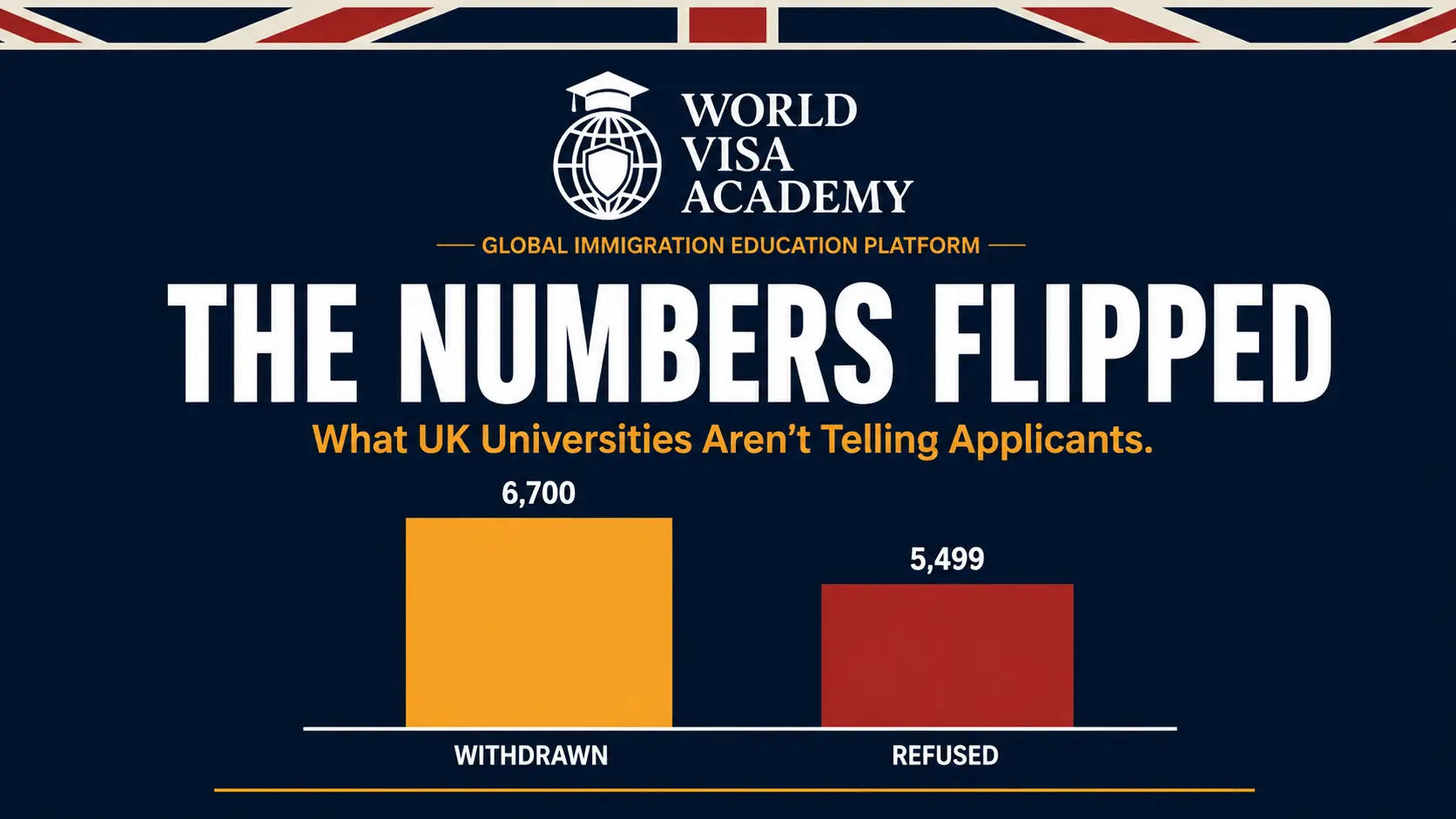

Here is a statistic that sounds almost reassuring until you understand what is actually behind it. In the first quarter of 2026, 6,700 UK student visa applications were withdrawn, more than double the previous record. In that same quarter, around 5,499 applications were formally refused. For the first time in at least 20 years, withdrawals outnumbered refusals.
If your first reaction is relief, that fewer people are being rejected, pause there. The real story is not that the UK got kinder. It is that UK universities have found a way to stop bad outcomes from ever reaching the refusal stage in the first place, and that has real consequences for anyone applying.
This is the detail almost nobody explains clearly, so let's be precise about it. A student visa application isn't usually withdrawn because the student changed their mind. It happens because a Confirmation of Acceptance for Studies, the CAS, gets cancelled.
Here's how it works. A university issues a CAS to confirm it will sponsor a student's visa application. If that university later decides to cancel the CAS, perhaps because something about the application looks risky, the visa application built on that CAS can no longer proceed. The university is required to notify UK Visas and Immigration when this happens. The student, notably, may or may not even be told.
Read that again. A student can have their path to studying in the UK quietly closed by their own university's internal decision, sometimes without a clear explanation reaching them directly. That is what sits behind a huge share of this year's withdrawal numbers, not students backing out on their own.
This is not universities being cautious for no reason. It is a direct, calculated response to a compliance system that now carries real financial and existential stakes for them.
Since June 1, 2026, the UK's Basic Compliance Assessment framework, paired with its Red-Amber-Green banding system, requires universities to keep their visa refusal rate below 5 percent. Cross that line, and a university risks formal sanctions. In the most serious cases, it can lose its licence to sponsor international students entirely, a catastrophic outcome for any institution that depends on international tuition income.
Think about the incentive this creates. If a university suspects an applicant might get refused, letting that application proceed and fail counts directly against their compliance score. Cancelling the CAS before that happens keeps the refusal off their record entirely, even though the practical outcome for the student, no visa, no UK study, is exactly the same either way. Universities are not doing this to be cruel. They are protecting their own survival, and students are absorbing the consequence.
Withdrawals climbing does not mean refusals are improving. They are getting sharply worse too, just from a smaller overall pool of applications.
Home Office figures show 35,625 sponsored study visas were granted between January and March 2026, the lowest first quarter total since 2020, down nearly a third compared to the same period in 2025, and 60 percent below the 2023 peak. Refusals, meanwhile, rose 56 percent year on year to 5,499 in that same quarter. About 13 percent of Q1 2026 applications were refused outright, double the proportion seen in 2025, and the highest refusal rate since 2015.
Looking at the wider 12 month rolling picture, the refusal rate stood at 4.9 percent as of the most recent data, sitting right at the edge of that critical 5 percent compliance threshold, with analysts projecting Q3 2026 could push the rolling rate past 5 percent entirely. For the full year ending December 2025, the headline figure looked more manageable at 4.1 percent, which shows just how sharply things have deteriorated in the opening months of 2026 specifically.
The pain here is not evenly spread. Looking at the six month period covering Q4 2025 through Q1 2026 compared to the same period the year before, refusal rates for several of the UK's biggest student source countries jumped dramatically.
| Country | Refusal Rate (Prior Period) | Refusal Rate (Q4 2025–Q1 2026) | Change |
|---|---|---|---|
| Pakistan | Just under 6% | 41% | Nearly 6x higher |
| Bangladesh | Lower | 26% | Sharp increase |
| Ghana | Lower | 26% | Sharp increase |
| Sri Lanka | Lower | 22% | Sharp increase |
| Nigeria | Lower | 20% | Sharp increase |
| China | Already very low | 99%+ approval | Essentially unchanged |
| United States | Already very low | 99%+ approval | Essentially unchanged |
Withdrawals follow the same pattern. Applicants from Pakistan alone accounted for 43 percent of all withdrawn applications in Q1 2026, and only eight student source countries saw more than 50 withdrawals each, meaning this crisis is concentrated in a specific group of markets rather than spread evenly across all international applicants.
No single policy explains this on its own. Three things are landing at the same time, and together they explain the full picture.
The compliance squeeze came first. The Basic Compliance Assessment and RAG banding system, tightened through 2026, is what's pushing universities to pre-emptively cancel risky CAS letters rather than risk a formal refusal on their record.
The Graduate visa got shorter. From January 2026, the post study work visa was cut from two years down to 18 months, a change experts have directly linked to softening demand, since a shorter guaranteed work window makes the UK a less attractive investment for some prospective students weighing their options against other countries.
An emergency brake landed on four specific countries. In March 2026, the Home Office took the unusual step of introducing an emergency pause on student visas for applicants from Afghanistan, Cameroon, Myanmar and Sudan, after asylum claims filed by people originally on student visas rose by more than 470 percent between 2021 and 2025. While this directly affects only those four nationalities, it has intensified scrutiny across the board, since universities and immigration officials are now watching for similar switching patterns from other markets too.
This is worth spelling out plainly, because the practical difference between "withdrawn" and "refused" matters enormously to the person living through it. A formal refusal comes with a documented reason and appears on that person's immigration history. A CAS withdrawal often arrives with far less clarity, sometimes no direct explanation from the university at all, leaving the student to piece together what happened and why.
For a family that has already paid a deposit, arranged finances, or turned down another offer, a quiet CAS cancellation can be just as devastating as an outright refusal, arguably worse, because there is often no clear appeals path and no detailed reasoning to work from. This is exactly why understanding this mechanism matters so much for anyone advising a client through the process.
| Factor | Formal Refusal | CAS Withdrawal |
|---|---|---|
| Who initiates it | UK Visas and Immigration | The sponsoring university, before UKVI even decides |
| Reason provided | Documented refusal reason given | Often minimal or unclear explanation |
| Shows on immigration record | Yes | Not in the same way, since no formal refusal was issued |
| Counts against university's compliance rate | Yes | No, which is precisely why universities prefer it |
| Student typically notified directly | Yes | Not always guaranteed |
| Appeal or reapplication clarity | Clearer path based on stated reason | Murkier, since the underlying concern may not be disclosed |
This is not a story about the UK quietly becoming more welcoming because fewer people are being formally refused. It is a story about universities under real institutional pressure making defensive decisions that shift risk onto applicants, often without full transparency. Understanding the mechanics behind these numbers, not just the headline figures, is exactly what separates advice that protects a client from advice that leaves them blindsided.
World Visa Academy's UK study visa training covers the Basic Compliance Assessment, CAS withdrawal risks, and country specific trends so you can prepare clients properly.
Explore WVA CoursYes. In the first quarter of 2026, 6,700 student visa applications were withdrawn compared to around 5,499 formal refusals, according to Home Office data. This is the first time in at least 20 years that withdrawals have outnumbered refusals in a first quarter.
Most withdrawals happen because a university cancels the student's Confirmation of Acceptance for Studies, or CAS, before the Home Office makes a formal decision. Once a CAS is cancelled, the visa application built on it can no longer proceed. The university must notify UK Visas and Immigration, but the student is not always directly informed of the reason.
Since June 1, 2026, UK universities have been required to keep their visa refusal rate below 5 percent under the Basic Compliance Assessment framework, or risk losing their licence to sponsor international students. Cancelling a risky CAS before it results in a formal refusal keeps that outcome off the university's compliance record, even though the practical result for the student is the same.
Pakistan has seen the sharpest impact by far, with its refusal rate jumping from under 6 percent to 41 percent, and Pakistani applicants accounting for 43 percent of all withdrawals in early 2026. Bangladesh, Ghana, Sri Lanka and Nigeria have also seen significant increases, while approval rates for applicants from China and the United States have remained above 99 percent.
A CAS withdrawal is generally less formally documented than an outright visa refusal, since no Home Office decision was actually made. However, the lack of a clear stated reason can make it harder for a student and their advisor to understand what went wrong and correct it before reapplying, which is why getting documentation right from the very first application matters more than ever this year.








0 Comments
Be the first to comment.