H-1B Registrations Dropped 38.5% This Year: What Every Consultant Advising US-Bound Clients Needs to Know
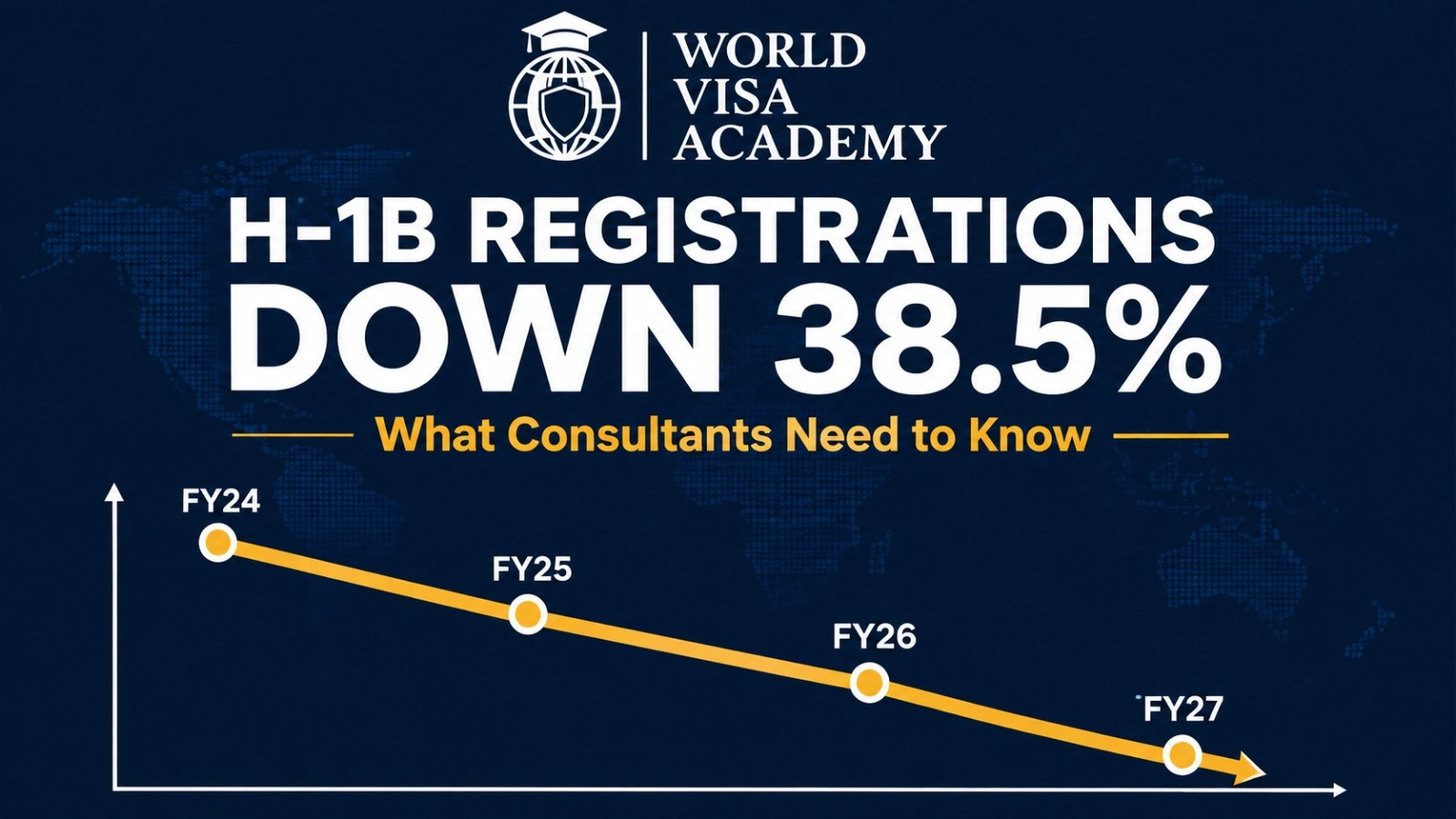

In May 2026, USCIS posted a number on social media that immigration lawyers, tech recruiters and hopeful applicants had been bracing for since the previous autumn. Properly submitted H-1B registrations had plummeted by 38.5 percent, falling from 343,981 in fiscal year 2026 to just 211,600 in fiscal year 2027.
That is not a small correction. That is the steepest single year drop the H-1B program has seen in its recent history, and it did not happen by accident. Three separate policy changes collided at once, and if you advise clients hoping to work in the United States, you need to understand all three, because each one changes the advice you should be giving right now.
To understand how dramatic this is, you have to zoom out further than one year. H-1B registrations peaked at nearly 781,000 in fiscal year 2024, a number so inflated by employers submitting duplicate registrations for the same candidate that it triggered a complete overhaul of the selection system.
| Fiscal Year | Eligible Registrations | Change From Prior Year |
|---|---|---|
| FY 2024 | ~781,000 (peak, multiple registrations allowed) | — |
| FY 2025 | 470,342 | Sharp decline after beneficiary centric reform |
| FY 2026 | 343,981 | Down 26.9% |
| FY 2027 | 211,600 | Down 38.5% |
The FY 2026 drop alone reflected a 20.5 percent decline in unique beneficiaries and a shift toward roughly one registration per person on average, down from 1.06 the year before, as USCIS's beneficiary centric selection process began cutting into the practice of filing multiple registrations for the same individual to improve lottery odds. FY2027 then compounded that decline with two entirely new pressures. Here is what they were.
For as long as most consultants have been in this business, H-1B selection was a pure lottery. Every eligible registration had an equal shot, regardless of salary or seniority. That changed for FY2027.
Starting in fiscal year 2027, USCIS implemented a weighted selection process that favors higher skilled and higher paid workers, based on the highest Occupational Employment and Wage Statistics wage level that the beneficiary's offered wage equals or exceeds. Registrations tied to Wage Level IV positions, the most experienced and highest paying tier, are entered into the selection pool four times. Wage Level III gets three entries, Wage Level II gets two entries, and Wage Level I, the entry level tier, gets just one entry, though every beneficiary is still only counted once toward the actual cap.
This rule was finalized by the Department of Homeland Security on December 29, 2025, and took effect on February 27, 2026, applying for the first time to the FY2027 registration season that opened in early March.
The result was immediate and visible in the data. An overwhelming 71.5 percent of selected candidates for FY2027 held a US master's degree or higher, compared to just 57 percent the year before, and only 17.7 percent of all selected registrations fell into the lowest wage category. This first cap season under the weighted system shows the registration environment changed materially, though USCIS itself has noted the data does not support attributing the entire decline to this one cause.
In plain terms: employers who could only offer an entry level salary, or who were registering candidates speculatively without a strong wage package, had far weaker odds this year, and many simply chose not to file at all.
On September 19, 2025, President Trump signed a proclamation titled Restriction on Entry of Certain Nonimmigrant Workers, which requires a $100,000 payment to accompany any new H-1B visa petition submitted after 12:01 a.m. eastern time on September 21, 2025, including petitions tied to that year's lottery cycle.
This is the detail consultants most often get wrong, so it is worth stating precisely. The fee applies specifically to H-1B beneficiaries who are outside the United States and do not already hold a valid H-1B visa at the time the petition is filed. It does not apply to a change of status or an extension or amendment of stay for someone already inside the US, which means an F-1 student switching to H-1B status after graduation is generally not subject to it. It also does not apply if the beneficiary already holds a valid H-1B visa.
Where it does apply, it applies fully, and $100,000 is not a fee most small or mid sized employers can absorb per hire. The proclamation primarily targets new H-1B petitions requiring consular processing, meaning candidates applying to enter the US for the first time from abroad.
The legal status, as of this writing, is genuinely unsettled, so treat it as fluid. A federal court in Washington DC upheld the fee's legality on December 24, 2025. Then, on June 8, 2026, a federal judge in Massachusetts reached the opposite conclusion, ruling the fee an unconstitutional tax and vacating the policy entirely. Just days later, that same judge paused his own ruling, temporarily reinstating the government's authority to keep collecting the fee while it appeals, and the government has since asked for that pause to remain in place for the full appeals process. A higher court will decide what happens next. Until then, the safest assumption for any client considering a new consular filing is that the fee is currently still being enforced, and that could change with little notice.
If you work with clients hoping to go through IT staffing or consulting placement models, you need to understand that this group has been affected disproportionately, and this predates FY2027.
A National Foundation for American Policy analysis of USCIS data found Indian based IT companies experienced a 70 percent decline in H-1B approvals for initial employment between FY2015 and FY2025. In FY2025 alone, the top seven Indian IT firms combined received just 4,573 approvals for new H-1B workers, 37 percent fewer than the year before, and only three India based companies made it onto the list of the top 25 H-1B hiring employers that year.
Compare that to the companies now dominating approvals. Amazon alone secured 4,644 approvals for initial employment in FY2025, more than all seven top Indian IT firms combined, while Meta received 1,555, Microsoft 1,394 and Google 1,050. The data suggests Indian IT companies are increasingly delivering services to US clients with fewer H-1B workers on the ground, while major US tech firms continue hiring aggressively, including foreign born graduates from American universities, to support AI investment.
This matters for the advice you give. A client whose only path was "get placed by a staffing consultancy" is now competing in a shrinking, weighted lottery where the biggest historical filers are pulling back sharply.
Indians make up an estimated 71 percent of all approved H-1B applications in recent years, according to USCIS data, with China holding the second largest share. Because of that concentration, a nationwide policy shift like this one does not land evenly. It lands hardest on exactly the client base most WVA trained consultants work with every day.
There is also a macroeconomic angle worth knowing if a client asks why this matters beyond one visa. India Ratings and Research estimated that H-1B policy changes could trim India's remittances by up to 5 billion dollars in FY26, with a base case decline of around 2.8 billion dollars, a meaningful number given remittances reached 124.6 billion dollars in FY25 and have historically financed nearly half of India's goods trade deficit.
None of this means the door has closed. It means the profile of who gets through has changed, and your advice needs to reflect that.
Here is something worth raising with every client who is flexible about employer type. Certain employers are entirely exempt from both the 85,000 annual cap and the lottery altogether, including institutions of higher education, nonprofit research organizations, government research organizations, and nonprofit entities closely affiliated with a university. Cap exempt employers can file H-1B petitions year round, without waiting for the March registration window, and without entering the lottery at all.
Critically, cap exempt petitions are also not subject to the $100,000 proclamation fee that applies to new cap subject petitions. The trade off is real: academic and nonprofit research pay commonly trails private sector salaries, and as cap subject odds tighten, more candidates are funneling toward these employers, making that route more competitive than it used to be. Still, for a client with a strong research or academic background, this deserves a serious conversation rather than being treated as a fallback nobody mentions until it's too late.
| Client Profile | FY2027 Reality |
|---|---|
| High wage offer, US master's degree, cap subject employer | Strongest odds under weighted selection; four entries at Wage Level IV |
| Entry level wage offer, cap subject employer | Weakest odds; single entry, competing against far fewer but stronger registrations |
| Candidate outside the US, no prior H-1B, consular processing needed | Subject to the $100,000 fee if currently enforced; confirm status before committing |
| Candidate already in the US on F-1, changing status | Generally not subject to the $100,000 fee |
| Candidate targeting a university, nonprofit research or government research employer | No lottery, no cap, no proclamation fee, but lower typical salary |
| Candidate relying on a staffing or IT consultancy placement | Facing the sharpest historical decline in approvals among all employer categories |
Clients will ask why their friend got selected last year with a lower salary and they did not this year. The honest answer is that FY2027 is the first cycle under a completely different selection mechanism, so past outcomes are no longer a reliable guide. Clients will also ask if the $100,000 fee is still in effect. The honest answer, as of now, is yes for qualifying new consular filings, though this is under active appeal and could change. Being upfront about this uncertainty builds more trust than offering false confidence in either direction.
The broader lesson for anyone building a career advising US bound clients is that this program is now genuinely more complex than a simple lottery, and staying current on wage rules, fee litigation and employer categories is no longer optional expertise. It is the baseline.
World Visa Academy's US immigration training covers live policy changes like wage weighted selection and fee rules, so you can advise clients with confidence, not guesswork.
Explore WVA CoursesThree factors combined at once. USCIS introduced a wage weighted selection process that gives higher paying job offers a much stronger chance of selection, discouraging employers from registering entry level candidates speculatively. A $100,000 fee took effect in September 2025 for many new petitions involving candidates outside the US. And employers who historically relied on high volume, lower wage filings, particularly IT staffing and consultancy firms, pulled back sharply after years of already declining approvals.
No. It applies specifically to new H-1B petitions filed for beneficiaries who are outside the United States and do not already hold a valid H-1B visa. It generally does not apply to candidates changing status from within the US, such as F-1 students, or to those who already hold H-1B status. The fee's legal status is currently being contested in federal court, so confirm current enforcement before advising a client on cost.
Instead of one random entry per beneficiary, USCIS now assigns multiple entries based on the offered wage level for the role, using Department of Labor wage data. A Wage Level IV offer, the highest tier, receives four entries in the selection pool, while a Wage Level I offer receives just one, even though each beneficiary is still only counted once against the annual cap regardless of entries.
Yes, disproportionately, simply due to volume. Indian nationals have historically made up an estimated 71 percent of approved H-1B applications, with China a distant second. Indian IT and staffing firms specifically have also seen the sharpest historical decline in approvals of any employer category, which compounds the impact of this year's changes for that client segment.
Yes. Employers such as universities, nonprofit research organizations and government research organizations are exempt from both the annual cap and the lottery, can file petitions year round, and are not subject to the $100,000 proclamation fee. The trade off is that pay at these institutions commonly runs below private sector levels, and this route has become more competitive as tighter lottery odds push more candidates toward it.








0 Comments
Be the first to comment.