Canada, UK and Australia All Got Stricter: Where Should Indian Students Go in 2026–27?
If you have been reading visa news at 1 a.m. while your parents ask whether this is still worth it, here is the straight answer.
2026 is stricter almost everywhere, but "stricter" is not "closed," and it hit some countries far harder than others.
Canada cut study permit numbers. Australia raised fees and funds. The UK shortened post-study work. The US got slower and harder to predict. But Ireland and New Zealand changed the least, with no enrolment caps, clear post-study work rights and steady processing.
The door has not closed. The smart move has changed.
Canada capped study permits at roughly 7 percent fewer in 2026 than 2025, and now requires a Provincial or Territorial Attestation Letter for most applicants. Critically though, university master's graduates are exempt from the field-of-study restriction on the post-study work permit, which means Canada's post-study door remains very much open for the right applicant.
The UK shortened the Graduate Route from two years to 18 months and tightened financial requirements.
Australia raised both visa fees and required funds, while maintaining a tighter cap on visa approvals. Its total degree cost has climbed past ₹80 lakh.
The US became slower and less predictable rather than formally capped.
The move away from the traditional four is not sentimental. It is financial.
Living costs in Toronto now exceed ₹1.5 lakh per month. A Canadian degree represents a ₹55 to 80 lakh total investment. Australian degrees pass ₹80 lakh.
Families borrowing ₹40 to 70 lakh cannot afford to choose a destination on familiarity alone. That single sentence explains most of what is happening in Indian student mobility right now.
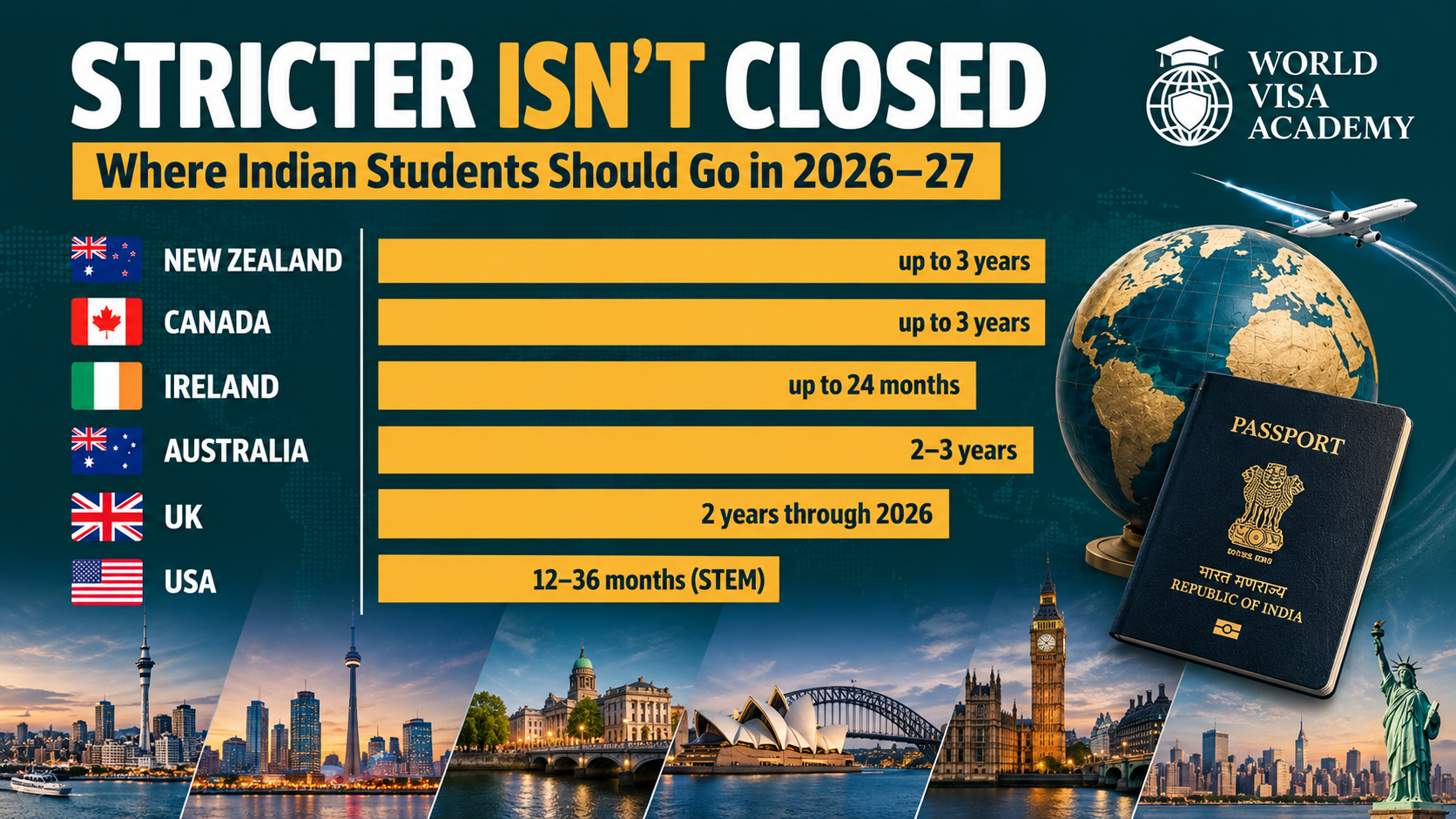
| Country | Post-Study Work Duration | Enrolment Cap? |
|---|---|---|
| New Zealand | Up to 3 years for the right qualification | No |
| Canada | Up to 3 years (PGWP) | Yes, ~7% cut in 2026 |
| Ireland | Up to 24 months for master's | No |
| Australia | 2 to 3 years | Tighter approval cap |
| UK | 18 months | No, but tightened finances |
| US | 1 year OPT plus 2-year STEM extension | No formal cap |
Ireland deserves serious attention, and it rarely gets it.
No enrolment cap. Up to 24 months stay-back for master's graduates. Steady processing. It is one of the most stable options available in 2026, and it is English-medium, which removes the language barrier that makes Germany harder for some students.
Ireland is particularly strong for technology, pharmaceuticals and finance graduates.
The honest trade-off: cost of living and tight housing, especially in Dublin. That is a real constraint, not a footnote, and it should be budgeted for properly.
For STEM graduates willing to learn German, the arithmetic is difficult to argue with.
Near-zero tuition versus CAD 20,000 to 35,000 per year in Canada is a significant gap over a full degree. Germany also offers the fastest PR pathway in Europe through the EU Blue Card, achievable in around 21 months with B1 German, which is faster than Canada's Express Entry timeline.
Germany has also maintained a stable and accessible visa regime while others tightened.
The trade-off is the language. B1 German is a genuine commitment, and students unwilling to make it should not choose Germany on cost alone.
Despite the tightening, Canada remains the most structured, predictable route to permanent residency. The three-year PGWP is explicitly designed to maximise Express Entry points through the Canadian Experience Class.
The conditions attached in 2026: you need a Provincial or Territorial Attestation Letter, you face a reduced permit pool, and rejection risk is genuinely elevated, with some analyses citing rejection rates as high as 74 percent for Indian applicants.
Where it still works well: a university master's, which exempts you from the PGWP field-of-study restriction entirely.
Beyond Germany and Ireland, several destinations are actively courting Indian students: Japan, South Korea, and the UAE, all offering growing economies, reasonable job markets and comparatively straightforward student visa processes.
The UAE in particular has become increasingly viable if proximity to home and tax-free income matter to your long-term plan.
The honest method is to decide what you are actually optimising for, then match a country to it.
| Your Priority | Best Fit | Why |
|---|---|---|
| Lowest total cost | Germany | Near-zero tuition at public universities |
| Fastest PR in Europe | Germany | EU Blue Card in ~21 months with B1 German |
| Most stable process right now | Ireland or New Zealand | No caps, steady processing |
| Most structured PR route | Canada | PGWP feeds directly into Express Entry |
| English-medium tech and pharma | Ireland | Strong sector presence, 24-month stay-back |
| Shortest degree duration | UK | One-year master's reduces total cost |
| Proximity and tax-free income | UAE | Close to home, growing job market |
| Longest post-study stay | New Zealand or Canada | Up to 3 years |
This is the most actionable line in all the current guidance:
Underfunded and rushed applications, not bad luck, cause most refusals now.
With caps and prioritisation in play, early, well-documented applications have the clear advantage. The students who struggle are the ones who apply late or under-fund their financial documentation.
That means your preparation matters more than your destination choice in determining whether you actually get in.
There is no single best country, and anyone who gives you one without asking about your field, budget and goals is not advising you properly.
What has genuinely changed is that familiarity is now an expensive way to choose. Germany, Ireland, New Zealand and increasingly Japan, South Korea and the UAE are not compromises. Several offer lower total costs, faster PR pathways and equally recognised degrees.
What they require is more research, less herd mentality, and willingness to plan around a different set of rules.
World Visa Academy's study abroad training covers destination comparison, documentation standards and current policy across 80+ countries.
Explore WVA CoursesYes, for the right applicant. Canada capped study permits at about 7 percent fewer in 2026 than 2025 and requires a Provincial or Territorial Attestation Letter for most applicants. However, university master's graduates are exempt from the field-of-study restriction on the post-study work permit, and the three-year PGWP still feeds directly into Express Entry, making it the most structured PR route available.
Ireland and New Zealand. Both maintained no enrolment caps, clear post-study work rights and steady processing while Canada, the UK and Australia tightened. Ireland offers up to 24 months stay-back for master's graduates, and New Zealand up to three years for the right qualification.
Substantially, for STEM students willing to learn German. German public universities charge near-zero tuition against CAD 20,000 to 35,000 per year in Canada. Germany also offers a faster PR route via the EU Blue Card, achievable in around 21 months with B1 German, compared to Canada's Express Entry timeline.
New Zealand and Canada offer up to three years for the right qualification, Ireland gives 24 months for a master's, Australia two to three years, the UK 18 months after its recent shortening, and the US one year of OPT plus a two-year STEM extension.
Underfunded and rushed applications, not arbitrary bad luck. With caps and prioritisation in effect across several destinations, early and well-documented applications have a clear advantage. Funds and demonstrating genuineness are what decide outcomes, so preparation quality often matters more than destination choice.








Would you like to read this article in Hindi?
0 Comments
Be the first to comment.