Canada Just Ran Four Express Entry Draws in a Single Week

Four Draws, Four Days, One Very Busy Week
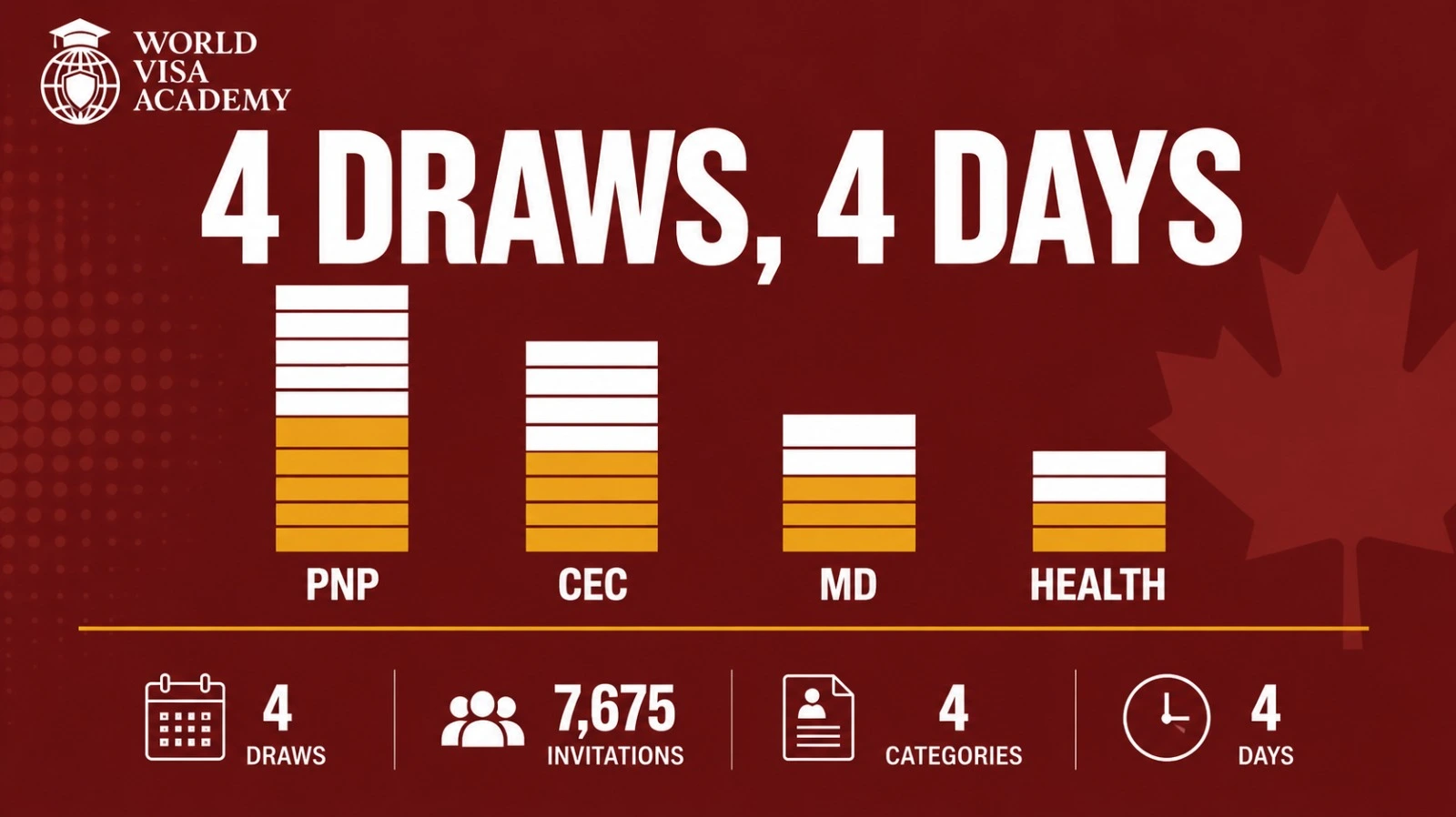
Most weeks, Express Entry watchers get one draw to analyze, maybe two if it's a busy stretch. Between August 31 and September 4, 2026, IRCC ran four separate rounds back to back, each targeting a completely different group of candidates, with CRS cutoffs ranging from as low as 198 to as high as 697 within the same seven day span.
That range alone tells you something important. Canada isn't running one immigration system right now. It's running several parallel ones at once, each with its own logic, its own competition level, and its own odds, and understanding all four is the only way to actually make sense of where you, or your client, stand.
Breaking Down the Week, Draw by Draw
August 31: Provincial Nominee Program, 562 ITAs, CRS 697. The week opened with a PNP round, and the high cutoff reflects exactly what you'd expect from this category. PNP draws only invite candidates who've already secured a provincial nomination, a pool of generally strong applicants competing against each other, which consistently pushes PNP cutoffs well above other categories.
September 1: Canadian Experience Class, 2,000 ITAs, CRS 521. CEC has been the workhorse of 2026, and this draw kept that pattern going, landing just under the year's CEC high of 523, set two weeks earlier on August 18. CEC draws select candidates who already have Canadian work experience, generally people already living and working in the country, transitioning from temporary to permanent status.
September 3: Physicians with Canadian Work Experience, 229 ITAs, CRS 198. This is where the week gets genuinely interesting. A CRS score of 198 is dramatically low compared to every other category running this year, and it's not because the bar for physicians is somehow lower. It's because the eligible pool is tiny.
September 4: Healthcare and Social Services Occupations, 3,500 ITAs, CRS 475. The week closed with its biggest round by volume, a broad healthcare category pulling in nearly double what the CEC draw issued just three days earlier.
The Physicians Category: Why CRS 198 Isn't What It Looks Like
If you only glance at the numbers, a CRS cutoff of 198 looks like the easiest draw of the year by a wide margin, less than half of CEC's 521. That reading would be a mistake, and it's worth explaining clearly to anyone who asks.
The physicians category was built specifically for doctors who already have Canadian work experience. To even qualify, an applicant needs at least 12 months of full time, or equivalent part time, Canadian work experience as a medical doctor within the past three years, on top of meeting the standard requirements of one of the three core Express Entry programs. That's a narrow, specific bar to clear before CRS even comes into play. With so few candidates able to meet it in the first place, IRCC simply doesn't need a high score to fill 229 spots. A low cutoff here reflects a small, specialized pool, not an easy pathway open to anyone.
This is also a genuinely new category for 2026, one of nine categories the Minister of Immigration defined for the year, alongside French language proficiency, healthcare and social services, STEM occupations, trades, education, senior managers with Canadian experience, researchers with Canadian experience, and skilled military recruits.
Healthcare Draw: The Week's Biggest Round
The September 4 healthcare and social services draw was the clear volume leader of the week, issuing 3,500 invitations at a CRS cutoff of 475. Unlike the narrow physicians category, healthcare and social services casts a much wider net, covering a broad range of occupations across the sector, which explains both the higher invitation count and the more moderate cutoff compared to CEC.
Looking at the category's range across 2026 so far, healthcare and social services cutoffs have moved between 462 and 510, placing this latest round roughly in the middle of that band, a steady, unspectacular result for a category that's clearly become one of IRCC's reliable, high volume tools this year.
CEC: Still Carrying 2026
Zoom out from this single week, and Canadian Experience Class remains the backbone of the entire year. As of the most recent count, CEC has issued roughly 51,250 invitations across 15 separate draws in 2026 alone, comfortably the largest single category by total volume. CEC cutoffs this year have stayed in a fairly tight band, between 507 and 523, and the September 1 draw's 521 sits right near that year long ceiling.
This consistency matters for anyone with Canadian work experience sitting in the Express Entry pool. CEC draws have shown up roughly every two weeks throughout 2026, making it one of the more predictable categories to plan around, even as its per-draw volume has started to taper off compared to the unusually large rounds seen earlier in the year.
PNP: The Quiet Anchor of the Week
The Provincial Nominee Program draw that opened the week, 562 ITAs at CRS 697, is a reminder that not every Express Entry pathway is getting easier. PNP cutoffs in 2026 have ranged as high as 805 and as low as 697, meaning this particular round actually landed at the lower end of that range, a relatively better outcome within an otherwise consistently demanding category. Since PNP invitations require a provincial nomination first, this category continues to reward candidates who've already built a genuine connection to a specific province, rather than competing purely on a federal CRS score.
2026 So Far: The Bigger Number Behind the Week
Zooming all the way out, this single week's four draws were part of round numbers 438 through 441 in IRCC's 2026 sequence, meaning the September 4 healthcare draw marked the year's 53rd Express Entry round. Cumulative invitations issued in 2026 have now passed 126,000, a running total that includes everything from massive French language proficiency rounds, like the 5,000 ITA, CRS 382 draw held on August 19, to small, targeted rounds like the physicians category.
That 126,000-plus figure, reached with roughly a third of the year still remaining, gives a sense of just how much category-based selection has reshaped Express Entry. A system that used to run almost entirely on general CRS ranking now spends much of its energy targeting narrow, specific groups, healthcare workers, French speakers, physicians, tradespeople, each with a wildly different bar to clear.
What's Coming Next: The 2027 Categories Consultation
Here's a detail worth flagging to anyone planning further ahead than this year. IRCC closed a public consultation on September 1, 2026, the very same week as these four draws, gathering input on which economic priorities should shape category-based selection for 2027. The government has indicated it's weighing how to continue addressing long-term labour shortages, attracting and retaining talent, and supporting Francophone immigration outside Quebec.
In plain terms: the nine categories running in 2026 are not guaranteed to look the same next year. A category that exists today, like physicians with Canadian work experience, could be reshaped, replaced, or joined by something new entirely once 2027 planning firms up.
This Week's Four Draws at a Glance
| Date | Category | ITAs Issued | CRS Cutoff |
|---|---|---|---|
| August 31 | Provincial Nominee Program | 562 | 697 |
| September 1 | Canadian Experience Class | 2,000 | 521 |
| September 3 | Physicians with Canadian Work Experience | 229 | 198 |
| September 4 | Healthcare and Social Services Occupations | 3,500 | 475 |
What This Means for Candidates and Consultants
Quick Checklist Before Advising an Express Entry Client This Month
The Bigger Lesson From This Week
A single busy week like this one is really a compressed snapshot of where Express Entry stands in 2026: fragmented into distinct, purpose-built lanes, each moving at its own pace and its own price. The advisors who can explain, clearly and specifically, which lane a client actually belongs in, rather than quoting a single generic CRS number, are the ones giving advice people can actually act on.
World Visa Academy's Canada Express Entry training covers every category-based draw, CRS trends, and provincial nomination strategy, so you can match each client to the right lane.
Explore WVA CoursesIRCC increasingly runs category-based draws alongside its regular Canadian Experience Class and Provincial Nominee Program rounds, and several categories happened to align in the same week. Between August 31 and September 4, 2026, this included a PNP draw, a CEC draw, a Physicians with Canadian Work Experience draw, and a Healthcare and Social Services draw, each targeting a different pool of candidates.
The low cutoff of 198 reflects a small, highly specific eligible pool rather than an easier pathway. Applicants must have at least 12 months of Canadian work experience as a medical doctor within the past three years to even qualify, a narrow bar that limits how many people can compete for the 229 available invitations.
More than 126,000 invitations had been issued across 53 rounds as of the September 4, 2026 healthcare draw, making 2026 one of the most active years yet for category-based Express Entry selection.
Canadian Experience Class leads by volume, with roughly 51,250 invitations issued across 15 separate draws so far in 2026, making it the most consistent and highest volume pathway for candidates with Canadian work experience.
Not necessarily. IRCC closed a public consultation on September 1, 2026 gathering input on which economic priorities should shape category-based selection for 2027, including long-term labour shortages, talent attraction and retention, and Francophone immigration outside Quebec. The current list of categories could change once that planning is finalized.









0 Comments
Be the first to comment.