Beyond the Big Four: Where International Students Are Actually Going Now, and Why
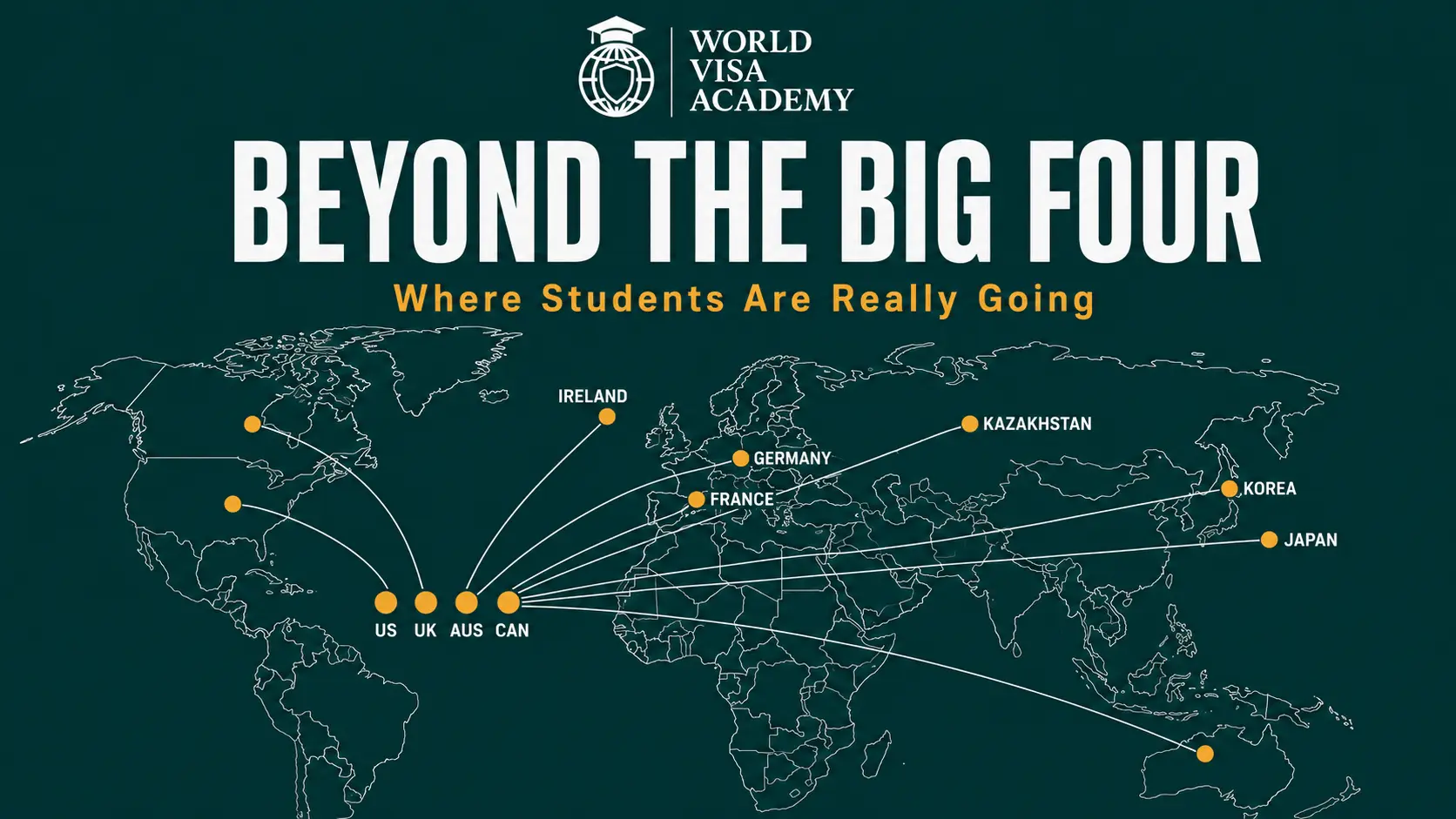

For decades, choosing where to study abroad usually meant picking between the United States, the United Kingdom, Australia and Canada. That is no longer the default conversation, and the numbers back this up clearly.
Leading up to the pandemic, these four countries together hosted roughly four out of every ten internationally mobile students in the world. QS projects that combined share will slip closer to one third by 2030, with destinations across Europe, Asia and the Middle East picking up the difference. Looking specifically at English taught programmes, the Big Four's share has already dropped to 78 percent this year from 82 percent in 2021, while South Asia has more than doubled its English taught programme offerings since 2019, and China, the Middle East, North Africa and the rest of Asia have doubled theirs too.
This is not a sudden collapse. It is a steady, multi year rebalancing, and understanding why it is happening changes how you should be advising clients today.
The honest driver behind this shift is not that emerging destinations suddenly became irresistible overnight. It is that Big Four countries have been making themselves harder and more expensive to reach, right as a wider field of countries has been genuinely improving.
Australia offers the clearest example. Its standard student visa fee has risen from AUD 710 before July 2024 to AUD 1,600 that July, then AUD 2,000 in 2025, and AUD 2,500 from July 1, 2026, a cumulative increase of roughly 285 percent since 2022. Its post study work visa fee has more than doubled over the same period, reaching AUD 5,750 by mid 2026. The government has held its National Planning Level for new student commencements at 295,000 for both 2026 and 2027, roughly 8 percent below the immediate post pandemic peak, while its own data shows actual commencements tracking below even that reduced target, and its vocational education sector alone lost 49 percent of its international students between 2024 and 2025.
Canada is the only Big Four country with a hard legal cap on international enrolment, and that cap has been shrinking. The 2026 target sits at 408,000, more than half of which are extensions for students already in the country, a figure 7 percent lower than the 2025 target of 437,000 and 16 percent lower than 2024's target of 485,000.
The UK hosted 685,565 international students in the 2024–25 academic year, down from 732,285 the year before, and the latest government reporting shows enrolments running 9 percent lower in January 2026 compared to the same period the previous year. The UK is now running neck and neck with Australia in total international student population, a position it has not been in for years.
Set against that backdrop, it becomes much easier to understand why a widening field of alternative destinations has started picking up meaningful share.
South Korea is the standout story of this shift. The government's "Study Korea 300K" plan aimed to reach 300,000 international students by 2027. It hit that target nearly two years early, and by February 2026 the country hosted 314,397 international students, of whom about 239,000 were enrolled in degree programmes. Vietnam is now the largest source country by far, followed by China, Uzbekistan and Mongolia. Growth has been extraordinarily fast: from around 160,000 students in 2019 to over 314,000 just seven years later.
Japan hosted more than 336,000 international students as of 2024, up 21 percent from the year before, and is working toward a longer term target of 400,000 by 2033.
Germany currently hosts around 420,000 international students according to DAAD data, with three quarters of its universities reporting stable or rising new enrolments, a strong pull given that most German public universities charge little or no tuition.
France also enrols more than 400,000 international students and continues expanding its English taught programme offerings, making it increasingly accessible to students without strong French language skills.
Ireland reached an all time high of more than 40,000 international enrolments in 2023 to 2024, with many EU students in particular shifting toward Ireland as UK policy has grown less predictable for them, though long visa wait times and accommodation shortages remain real challenges there.
Kazakhstan enrolled more than 35,000 international students in 2025, mainly from India, Turkmenistan, Uzbekistan, China and Russia, and is targeting 100,000 by 2028. It is increasingly positioning itself as a stable, accessible alternative to Russia, whose own international standing has suffered amid the war in Ukraine.
Malaysia, Singapore, Thailand and South Korea all showed strengthening student search and enrolment demand through late 2025, alongside continuing momentum for Spain and Italy in Europe.
Smaller, newer entrants are part of this picture too, though usually in specific niches rather than broad competition with the Big Four. Azerbaijan, for instance, has grown its international student population by 70 percent over five years to nearly 11,000 students, driven almost entirely by demand for affordable, WHO recognised medical degrees from students in Türkiye, India, Pakistan and Bangladesh. It is a genuine, worthwhile option for the right client, but it operates at a fundamentally different scale than the countries above.
| Destination | Approx. International Student Population | Recent Trend | Standout Strength |
|---|---|---|---|
| South Korea | 314,397 (Feb 2026) | Hit 300K target 2 years early; up sharply since 2019 | Fast growing, strong government backing, K culture appeal |
| Japan | 336,000+ (2024) | Up 21% year over year | Targeting 400,000 by 2033, strong academic reputation |
| Germany | ~420,000 | 3 in 4 universities reporting stable or rising enrolment | Largely tuition free public universities |
| France | 400,000+ | Growing English taught programmes | Strong for business and humanities, EU access |
| Ireland | 40,000+ (all time high) | Fourth straight year of growth | Gaining EU students shifting from the UK |
| Kazakhstan | 35,000+ (2025) | Targeting 100,000 by 2028 | Stable, affordable alternative to Russia |
| Azerbaijan | ~11,000 | 70% five year growth | Affordable, WHO recognised medical degrees |
| Australia (for comparison) | ~295,000 targeted new commencements | Tracking below target; visa fees up 285% since 2022 | Still large scale, but rising cost is now a real barrier |
Looking across South Korea, Japan, Germany, France and the others, a few shared traits stand out. Each has made a deliberate, well funded government commitment to internationalisation, with explicit public targets rather than vague ambitions. Each has kept costs genuinely competitive, whether through low or no tuition, as in Germany, or through visa and living costs that remain far below the Big Four's rapidly rising fees. And each has invested in academic quality improvements that show up in independent rankings, not just in marketing material, which is part of why eight Asian cities now appear in QS's top 20 Best Student Cities ranking.
This shift is not a passing trend. It reflects a genuine rebalancing of global student mobility, driven by Big Four countries raising costs and tightening policy at the same time that a wider field of countries has been investing seriously in quality, affordability and clear government commitment. For consultants and agents, staying current on this map is no longer optional specialist knowledge. It is quickly becoming the baseline expectation from clients who are researching these options themselves before they ever walk into your office.
World Visa Academy's study abroad consultant training covers real, current enrolment data and visa rules across established and emerging destinations in over 80 countries.
Yes, measurably. The combined share of internationally mobile students hosted by the US, UK, Australia and Canada is projected by QS to fall from around 40 percent pre-pandemic to closer to one third by 2030. In English taught programmes specifically, their share has already dropped from 82 percent in 2021 to 78 percent this year, as other regions expand their offerings rapidly.
South Korea stands out clearly. It reached its target of 300,000 international students nearly two years ahead of schedule and hosted 314,397 students by February 2026, up from around 160,000 in 2019. Vietnam and China are currently its largest source countries.
Primarily cost and policy tightening. Australia's student visa fee has risen roughly 285 percent since 2022, its post study work visa fee has more than doubled, and its own government data shows new student commencements tracking below the national planning target, with the vocational education sector losing nearly half its international students in a single year.
They are strong options for specific situations rather than general alternatives. Kazakhstan and Azerbaijan are growing quickly but from small bases, and their appeal is concentrated in particular niches, affordable medical degrees in Azerbaijan's case, and a stable, lower cost alternative to Russia in Kazakhstan's case, rather than broad competition across all fields of study.
Three things consistently show up: a clear, publicly stated government target for international student growth, genuinely competitive costs whether through low tuition or affordable living expenses, and real, ranking backed improvements in academic quality rather than marketing alone. Germany, France, Japan and South Korea all fit this pattern clearly.








0 Comments
Be the first to comment.