Australia's New Rule: Students Can No Longer Bring Spouse or Children?
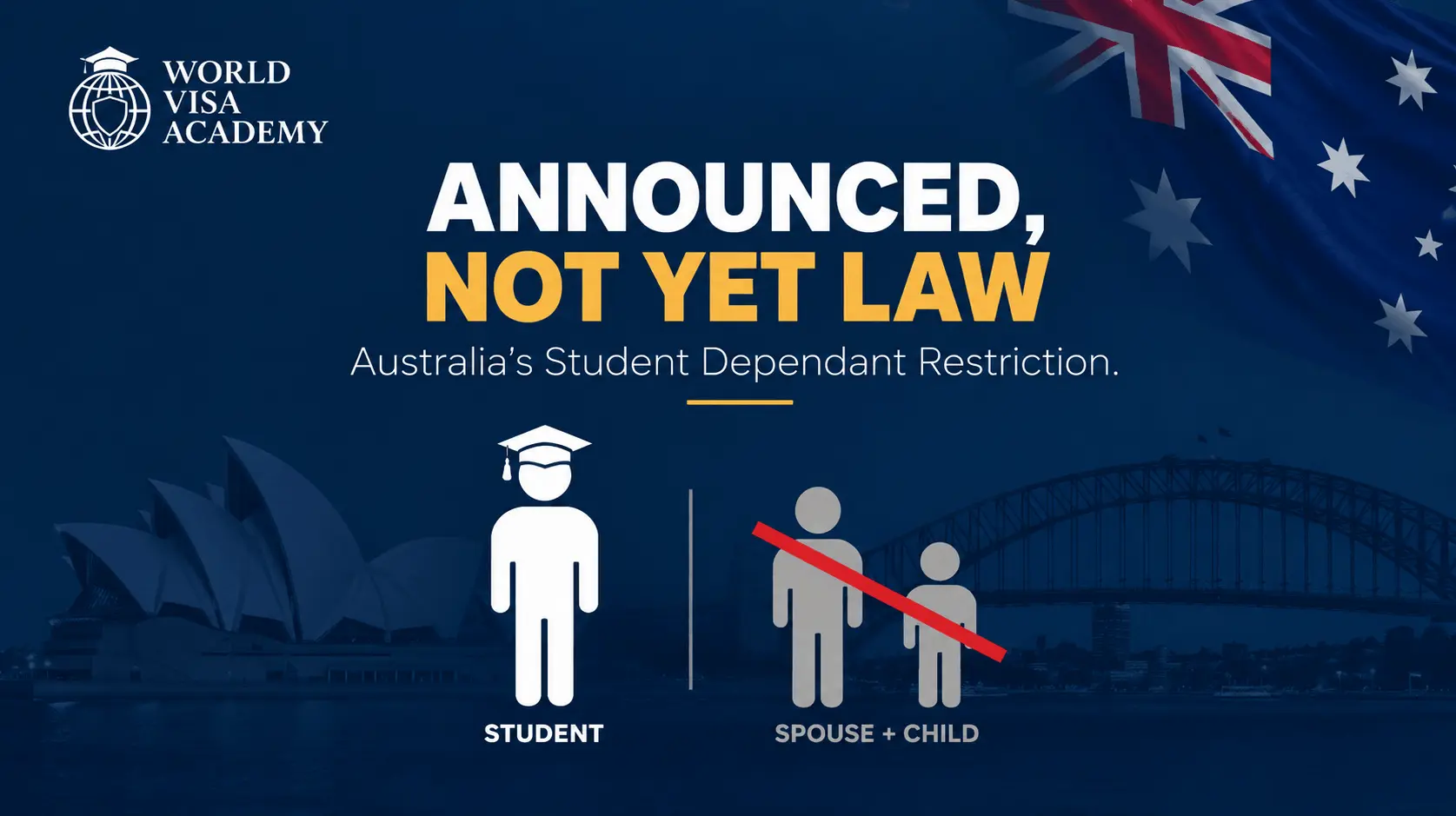

Here is the part most coverage buries, and it changes what you should do today.
This is an announcement, not yet a rule. On 17 September 2026, Home Affairs and Immigration Minister Tony Burke announced at the National Press Club in Canberra that most student visas will no longer allow secondary applicants. No commencement date has been published.
Right now, today, you can still include your partner and children on a Subclass 500 application. The Department of Home Affairs student visa page still describes the current process for including eligible family members.
But treat it as coming, not hypothetical. The change is expected to be made by regulation rather than legislation, meaning it does not need a parliamentary vote and can take effect quickly. Some reporting points to November 2026 as a discussed implementation point, though the government has only said changes will be progressively rolled out.
If bringing family matters to your plan, the window is open and it may not stay open long.
Under the proposal, most prospective international students on a Subclass 500 visa, and graduates on a Subclass 485 Temporary Graduate visa, will no longer be able to bring a partner or dependent children as secondary visa holders.
The government describes the measure as "restricting secondary applicants on most student visas," and frames it as closing what it calls the "student family pathway", which allowed secondary migrants to effectively enter Australia through a student visa holder.
Note that the graduate visa is included. A student who was planning to bring family during their post-study work period faces the same restriction.
A narrow set of exemptions has been announced:
PhD and postgraduate research candidates. Research-based Master's students appear to fall within this too.
Students from designated Pacific and ASEAN nations.
Government-sponsored students.
The pattern is clear: coursework Bachelor's and Master's degrees, which make up the bulk of Indian student enrolments in Australia, are squarely in scope. Research degrees are not.
The dependants change is one component of a wider migration package aimed at cutting net overseas migration from roughly 292,000 a year to 245,000 in 2026-27 and 225,000 in 2027-28.
Worth being precise about one point: student visa numbers themselves are not being reduced by this measure. It targets the visas granted to partners and children specifically, not the primary student intake.
Australia's approach closely mirrors a policy the United Kingdom introduced in 2024, when it barred most international students from bringing dependants and exempted only postgraduate research degrees.
The UK ban led to a sharp drop in overseas enrolments at the time. Some analysts believe that shift actually helped Australia remain attractive by comparison, despite its own rising costs and processing delays.
That comparative advantage now narrows. If you were choosing Australia partly because the UK closed this door, the calculation has changed.
Until commencement, you can include:
| Family Member | Eligibility |
|---|---|
| Spouse or de facto partner | Married, or genuine de facto relationship generally of at least 12 months |
| Dependent children | Under 18 |
| Partner's dependent children | Under 18 |
| Children aged 18 to 23 | Where financially dependent on you |
| Extended family (parents, siblings, cousins) | Not permitted, visitor visa 600 instead |
Registered relationships in some Australian states can substitute for the 12-month de facto rule in certain cases.
All family members must meet health and character requirements, and you must demonstrate you can financially support them.
If you do lodge now, budget properly for one item most people miss.
School-aged children of student visa holders must attend school, and international student fees generally apply at public schools. Fees differ by state and by year level.
The difference between states can be five figures a year. Some states discount or waive these fees for children of research students or scholarship holders. Check your state's education department before committing.
The government has said families already in Australia under an existing student visa arrangement will not be separated because of these changes.
That is a meaningful reassurance for students currently studying with dependants onshore.
Even under current rules, timing matters.
Come together when: you're doing a Master's or PhD, you have savings evidence ready, and childcare or school placement is arranged.
Come later when: you're in your first semester of a Bachelor or VET course, still finding stable work, and unsure about housing. Family rentals are considerably harder to secure with no Australian rental history.
That second scenario now carries new risk. "Come later" may mean "cannot come at all" if the rule commences in between.
This has not commenced. You can still act. But it is expected to arrive by regulation, which means it can land with little notice and without a parliamentary vote.
If bringing your spouse or children is central to why Australia works for you, the responsible move is not to wait and see. It is to confirm the current position, prepare complete documentation, and lodge while the pathway is open, or to seriously compare destinations where the door is not closing.
World Visa Academy's Australia study visa training covers dependant eligibility, evidentiary standards and live policy tracking in full detail.
Explore WVA CoursesFor now, yes. The change was announced on 17 September 2026 but has not commenced, and no start date has been published. The Department of Home Affairs student visa page still describes the current process for including eligible family members. Always confirm the position on the day you lodge.
The announced exemptions cover PhD and postgraduate research candidates, students from designated Pacific and ASEAN nations, and government-sponsored students. Coursework Bachelor's and Master's students, who make up the bulk of Indian enrolments, are in scope.
Yes. The same restriction is planned for Subclass 485 Temporary Graduate visa holders, who will generally not be able to have partners or children join them as secondary applicants during their post-study work period.
No. This particular measure targets visas granted to partners and children, not the primary student intake. It sits within a wider package aimed at reducing net overseas migration from roughly 292,000 a year to 245,000 in 2026-27 and 225,000 in 2027-28.
The government has stated that families already in Australia under an existing student visa arrangement will not be separated because of these changes. The restriction is directed at new applications rather than retroactively at those already onshore.








0 Comments
Be the first to comment.