Immigration Fraud Alert: Five Scams That Shook the Visa World This Week (August 1–7, 2026)
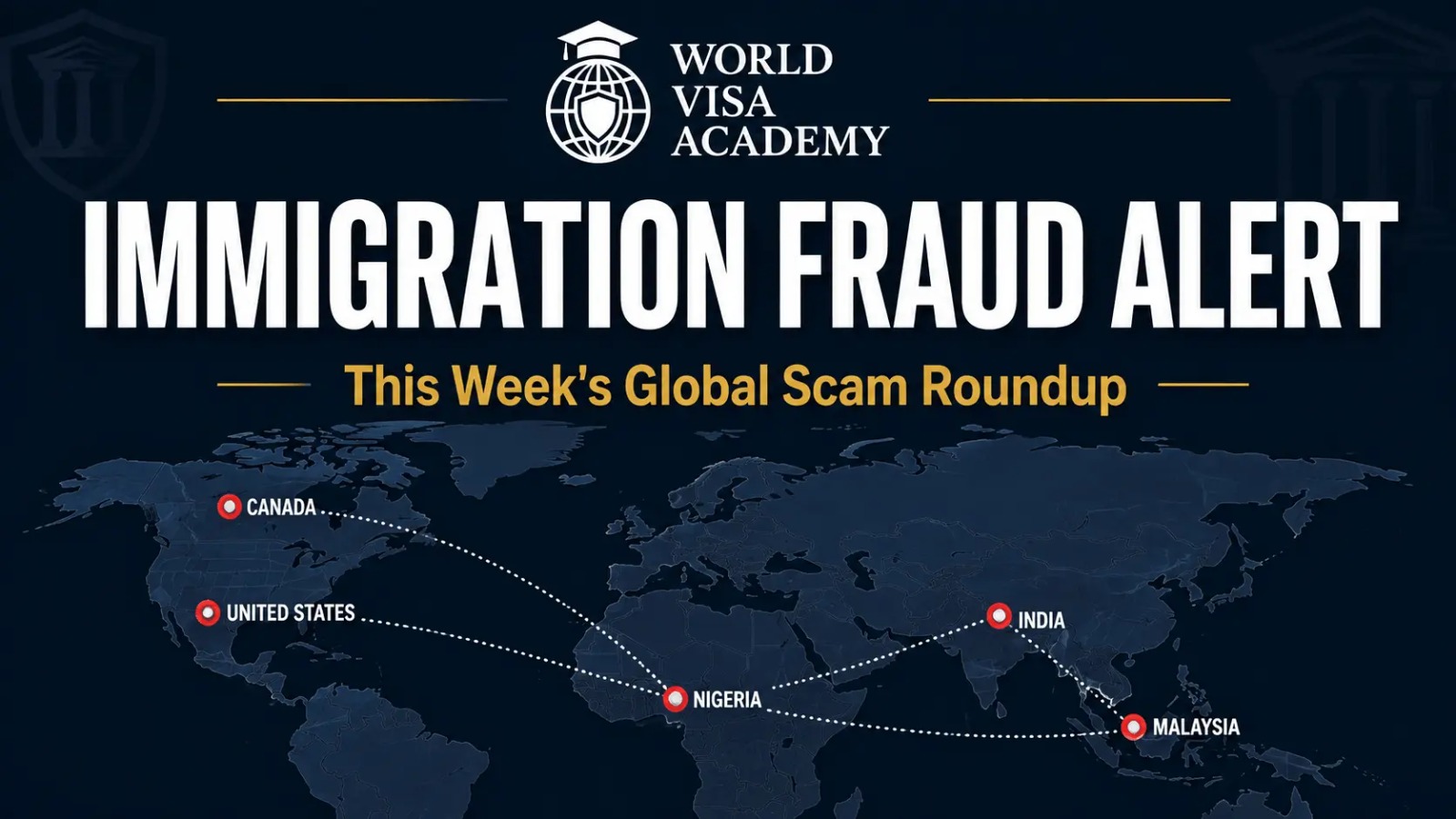

Between August 1 and August 7, 2026, immigration fraud made headlines on five different continents. A job offer in Punjab turned out to be a front for a cyber fraud network in the Philippines. Eight fraud cases were registered in Chandigarh in a single day. An illegal agent was arrested in Malaysia for forging work passes. A self styled travel consultant in Nigeria vanished with visa fees from more than ninety travellers. A business immigration dispute in Canada widened into a lawsuit against a government itself. And in the United States, a federal watchdog called part of the H1B visa program a criminal enterprise.
These are not isolated stories. Read together, they show something more useful than any single headline: the shape of how immigration fraud actually works today, and where the warning signs show up before the money disappears. This is essential reading whether you are applying for a visa yourself, working as a travel agent, or building a career as a licensed immigration consultant.
A report released this week by the Asia Pacific Group on Money Laundering, prepared jointly with the United Nations Office on Drugs and Crime, traced a fake recruitment scheme back to an investigation by the Cyber Crime Police Station in Patiala. Investigators identified 18 mule accounts linked to individuals from Patiala, Bathinda and Sangrur that allegedly channelled around ₹2.99 crore between February and June 2025. Four principal accused were arrested, and police recovered 231 SIM cards, 18 debit cards and multiple passbooks along with courier receipts.
The accused allegedly posed as human resources executives from reputed companies and promised overseas jobs in exchange for processing or document verification fees. As part of a supposed onboarding process, applicants were asked to open new bank accounts and hand over their passbooks, debit cards and registered SIM cards. Those activated bank kits were then shipped to fraud handlers based in the Philippines, where they were used to run online scam operations. The applicant did not just lose money. They became, without realising it, the tool used to commit fraud against someone else.
Consultant training tip: Warn clients that any job offer asking for banking access, however official it sounds, is never a normal part of onboarding.
On August 5, Chandigarh Police registered nine FIRs of cheating in a single day, eight of them involving visa and overseas placement consultancies across the city, with complainants alleging losses of more than ₹59 lakh on the promise of jobs and visas abroad. Cases were spread across four police stations, Sector 17, Sector 3, Sector 34 and Sector 36, with complainants from Punjab, Chandigarh, Delhi, Kerala and Chhattisgarh who had paid amounts ranging from ₹3.59 lakh to ₹15.93 lakh.
Police advised prospective migrants to verify the credentials and registration of immigration consultants before making payments, insist on written contracts and receipts, avoid cash transactions and independently confirm job offers with the concerned employer or embassy. When several unrelated firms in one city draw fraud complaints in the same week, it usually signals copycat operators exploiting the same gap in public awareness, not one rogue business
https://worldvisaacademy.com/course/visa-scam-awareness-training
Malaysia: The Agent Who Sold Fake Work Passes
A Myanmar national suspected of acting as an illegal agent was arrested in Selangor on August 1, 2026, following a joint operation by Malaysia's Immigration Department and the Malaysian Anti Corruption Commission conducted on July 28. Officers seized 16 Myanmar passports, a document believed to be a fake Temporary Work Pass, and a vehicle allegedly used by the network, while investigators found that some individuals linked to the agent held valid passes and others had no valid travel documents at all.
Community based trust, workers helping other workers from the same country, is often exactly what illegal agents exploit. Any work pass or permit should be verified directly with the issuing immigration authority through its official checking service, never through a middleman, however trustworthy they appear.
Police in Ondo State arrested a 33 year old woman, Adejoke Ayomide, on August 5 after a petition accused her of defrauding more than 90 intending travellers of over ₦42.3 million by presenting herself as a travel consultant capable of securing visas to Spain, Portugal and France. The petition alleged the fraud took place between October 2024 and April 2026, and that payments were collected through her personal mobile payment account before she became unreachable.
A single individual claiming to process visas for dozens of travellers to multiple Schengen countries at once is a scale warning sign on its own. Genuine visa processing at that volume runs through a registered agency, not a personal payment account.
A case involving Canada's Yukon Business Nominee Program, which offers a work permit and eventual permanent residency path to foreign nationals who start or buy a business in the territory, has grown well beyond its original claim. More than a year after a Whitehorse consultant was accused of steering an applicant into a business venture that collapsed and cost him roughly 500,000 dollars, a second person who used the same consultant has taken the unusual step of suing the Yukon government itself, alleging officials ignored warning signs in his file. His statement of claim, filed in January, alleges he lost roughly 556,843 dollars after investing in a business project he believed had been properly vetted, and further alleges the government did not disclose conflicts of interest involving his consultant and the project's Canadian partner. The government has filed a defence denying wrongdoing, stating officials must communicate through an applicant's designated representative and that it acted within program policy. None of the allegations have been proven in court.
Being licensed does not eliminate conflict of interest. When a consultant recommends a business partner or investment tied to their own immigration advice, that overlap deserves independent legal scrutiny, even when the paperwork looks proper.
On July 8, the US Department of Labor's Office of Inspector General launched a major investigation into fraud and human trafficking in the H1B and PERM visa systems, saying it had uncovered schemes in which employers and labor brokers submitted fraudulent applications and exploited foreign workers through coercive wage kickback arrangements. This week, Inspector General Anthony D'Esposito escalated the language further, describing the findings as a criminal enterprise that stretches far beyond the borders of America. Investigators have already issued dozens of subpoenas as part of the probe.
The core allegation is that some sponsored workers are required to pay back part of their wages, commonly called wage kickbacks, to the staffing networks or brokers who arranged their sponsorship. This is harder to spot than an outright fake visa because the visa itself is often genuine. Consultants advising employer sponsored applicants should specifically ask whether any part of a client's salary is expected to flow back to a third party after arrival.
| Location | Type of Fraud | Reported Scale | Status (as of Aug 2026) | Core Red Flag |
|---|---|---|---|---|
| Patiala, Punjab | Fake job offers feeding a cyber fraud network | ₹2.99 crore routed, Feb to Jun 2025 | 4 arrested | Job offer requiring a new bank account |
| Chandigarh | Fake visa and placement consultancies | ₹59 lakh+ lost in one day, 8 FIRs | Under investigation | No written contracts, cash payments |
| Selangor, Malaysia | Fake work pass documentation | 16 passports and fake pass seized | 1 arrested | Agent operating outside official government channels |
| Ondo State, Nigeria | Fake Schengen visa processing | ₦42.3 million from 93+ travellers | 1 arrested | Payments to a personal mobile account |
| Yukon, Canada | Undisclosed conflict of interest in business immigration | $556,843 claimed in second lawsuit | Civil case ongoing, unproven | Consultant arranged an undisclosed related business partner |
| United States | Wage kickbacks within a legitimate visa program | Federal investigation, dozens of subpoenas | Ongoing | Employer or broker demanding a share of wages back |
The pattern across all six cases is the same. At the lower end, fraud is getting more creative, turning applicants into unwitting participants in someone else's crime rather than simply taking their money. At the higher end, fraud is showing up inside licensed, regulated systems: a properly registered consultant, a government approved business program, a legitimate employer sponsored visa category.
Verification cannot stop at checking whether someone is licensed or a program is real. It has to extend to what is actually being asked of a client, and who benefits from the answer. This is exactly the judgment that separates a trained, ethical consultant from someone simply following a checklist, and it is a core reason structured, accredited training matters in this field.
World Visa Academy's accredited consultant training programs cover real world fraud patterns, verification standards and ethical practice across 80+ countries, so you can protect the people who trust you with their future.
Explore WVA CoursesSearch the official regulatory body for the country in question directly, rather than trusting a certificate or ID card shown to you. For Canada, this means checking the College of Immigration and Citizenship Consultants register. For the UK, check the Office of the Immigration Services Commissioner. Never use a phone number or website link the consultant themselves provides for verification, since fraudulent consultants sometimes set up fake verification pages. Cross check the firm's registered address and business name as well, not just the individual's name.
These bank accounts and SIM cards are used as mule accounts to move illicit money or run scam operations, often for entirely unrelated crimes overseas. The applicant becomes an unwitting participant, and can face serious legal exposure themselves if the account is later linked to fraud, even though they believed they were simply completing job verification. No legitimate employer or immigration process requires this.
Yes. Cash payments leave no financial trail, which makes it far easier for a fraudulent consultant to disappear once payment is received and far harder for victims or police to prove the transaction later. Always insist on payment to a verified business account along with a formal, dated receipt, and avoid any consultant who discourages this.
Stop all further payments immediately and gather every piece of documentation you have, including receipts, contracts, messages and bank transfer records. Report the matter to the nearest police station or the relevant consumer or immigration fraud authority in your country, and separately notify the regulator the consultant claimed to be licensed under, since fraudulent consultants are sometimes operating under a real license they do not hold.
In a typical scam, the visa itself is fake and never delivered. In wage kickback fraud, the visa and the job are often genuine, but the sponsored worker is pressured, formally or informally, to return part of their wages to the staffing agency or broker who arranged the sponsorship. This makes it far harder to detect since every document looks legitimate. Workers should keep detailed wage records and report any request to return part of their pay to the relevant labour authority.








0 Comments
Be the first to comment.