Australia Visa Fees Hiked From 1 July 2026 Full Fee Table and What It Means for Applicants
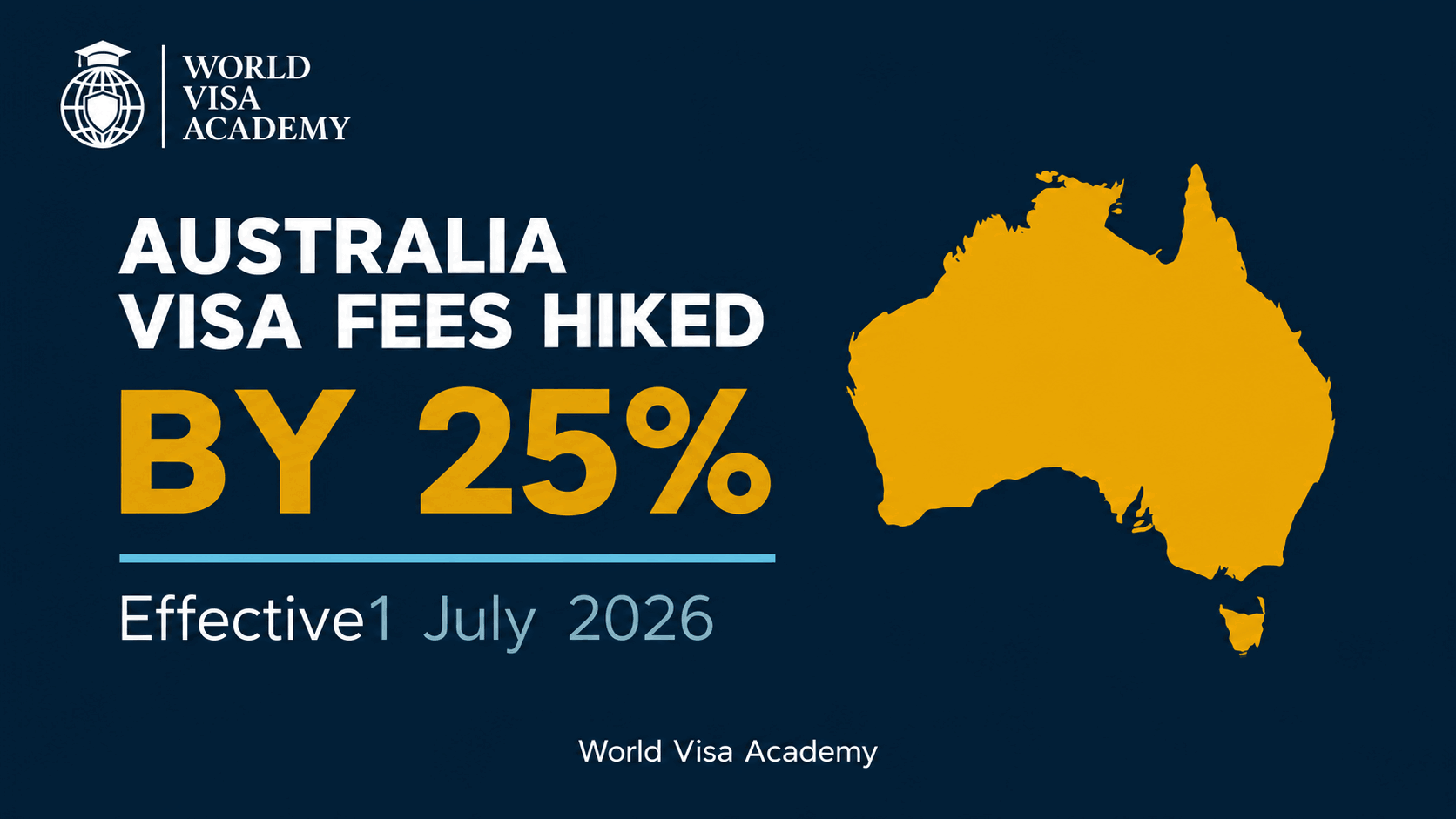

If you are planning to study, work, visit, or settle in Australia, you need to know this before you lodge your next application. From 1 July 2026, the Australian Department of Home Affairs raised visa application charges across almost every visa category, and in most cases the jump was much bigger than the usual yearly increase. In this post we explain exactly what changed, how much more you will now pay, why the Australian government did this, and what you should do if you are planning to apply.
Every year on 1 July, Australia adjusts its Visa Application Charges, commonly called VAC, in line with the Consumer Price Index. In a normal year, that increase is small, usually somewhere between 2 percent and 5 percent, adding a few hundred dollars at most even on the expensive visa categories.
This year was very different. On 1 July 2026, most Australian visa fees jumped by around 25 percent in a single step. On top of the Visa Application Charge increase, several related costs also went up on the same day, including the Temporary Skilled Migration Income Threshold, also called TSMIT, the Fair Work High Income Threshold, and fees for lodging a review with the Administrative Review Tribunal.
This was not a routine inflation adjustment. It was a deliberate policy decision connected to the Australian Government's 2026 to 27 Federal Budget, which was handed down on 12 May 2026.
The Australian Government has been steadily tightening its migration system for the past two years, through lower permanent migration ceilings, higher salary thresholds for sponsored visas, and tougher English language requirements for some study pathways. Industry commentators describe the 1 July 2026 fee increase as the clearest sign yet that the government is now using price as a tool to manage migration numbers, alongside quotas.
Visa fee revenue has also become an important source of income for the Australian Government. Migration fees are one of the few revenue levers the Department of Home Affairs can adjust without needing new legislation passed through Parliament. Industry estimates suggest that the earlier doubling of the Temporary Graduate visa fee in March 2026 alone was projected to raise more than 1.2 billion Australian dollars over five years. A broad 25 percent increase across almost the entire fee schedule extends that same revenue logic to nearly every applicant.
Below is a category by category breakdown of the main Visa Application Charges for the primary applicant. These are the base government charges only. Partners, children, agent fees, health checks, police clearance, and English test fees are all separate and add further cost on top of these figures.
| Visa Category | Subclass | Old Fee (AUD) | New Fee (AUD) | Approx Increase |
|---|---|---|---|---|
| Visitor Visa (Tourist Stream) | 600 | $200 | $250 | 25% |
| Student Visa | 500 | $2,000 | $2,500 | 25% |
| Temporary Graduate Visa | 485 | $4,600 (as of March 2026) | $5,750 | 25% |
| Skills in Demand / Employer Sponsored | 482 | $3,210 | $4,015 | 25% |
| Employer Nomination Scheme | 186 | $4,910 | $6,140 | 25% |
| Partner Visa | 820/801 | $9,365 | $11,710 | 25% |
| Australian Citizenship (Standard Conferral) | — | $575 | $595 | ~3% (CPI only) |
| Australian Citizenship (Concession) | — | $245 | $255 | ~3% (CPI only) |
Note: Working Holiday (417), Work and Holiday (462), Bridging Visa B, Resident Return, and New Zealand Citizen Family visas follow their own separate fee structure, and some of these rose by 200 percent or more. The eVisitor (subclass 651) and the Electronic Travel Authority (subclass 601), used by many short stay travellers, were left completely untouched and remain free or near free for eligible passport holders. Always confirm the exact figure for your specific visa subclass on the Department of Home Affairs website before you lodge, since fees can be revised at any time.
It is not just the Visa Application Charge that went up. Several connected numbers used across the Australian immigration system were also adjusted on the same date.
| Threshold or Fee | Old Value | New Value |
|---|---|---|
| Temporary Skilled Migration Income Threshold (TSMIT / CSIT) | $76,515 | $79,423 |
| Specialist Skills Income Threshold (SSIT) | $141,210 | $146,576 |
| Fair Work High Income Threshold (FWHIT) | $183,100 | $190,100 |
| Administrative Review Tribunal Migration Review Fee | Lower | Approximately $3,727 |
| Federal Circuit and Family Court Filing Fee | Lower | $4,180 |
The Temporary Skilled Migration Income Threshold matters a great deal for anyone applying for a Subclass 482 employer sponsored visa, because it is the minimum salary an employer must pay to sponsor a worker. If your job offer sits below $79,423 per year, you will not meet the threshold for sponsorship under current rules.
Imagine a software engineer from Ahmedabad who has a job offer from an Australian company and is being sponsored on a Subclass 482 visa. Before 1 July 2026, the base visa application charge was $3,210 and the minimum salary requirement was $76,515. After 1 July 2026, the same application now costs $4,015, an increase of $805, and the job offer must meet a higher salary bar of $79,423 to qualify for sponsorship at all.
Now imagine a student from Rajkot planning to study a postgraduate course in Melbourne and hoping to stay back afterward on a Temporary Graduate visa. The student visa itself now costs $2,500 instead of $2,000, and once studies are complete, the Graduate visa application, already increased once in March 2026, now costs $5,750. Combined with English testing, health checks, and police clearance, the total government charges alone for a study to work pathway can now cross 14,000 Australian dollars before any tuition or agent fees are even counted.
Not everything increased at the same pace. Visas linked to the eVisitor and Electronic Travel Authority categories saw no change at all. Citizenship application fees rose only by the usual small Consumer Price Index adjustment, around 3 percent, rather than the sharper 25 percent seen on most visa categories. Applicants from eligible Pacific Island countries and Timor Leste continue to receive concessional, lower fees under a dedicated Pacific regional pricing tier that the Department has now formally built into the fee schedule.
The most important thing to understand is that the fee is locked in on the date the Department of Home Affairs actually receives your application, not the date you complete your documents, not the date you sit an English test, and not the date your agent submits paperwork on your behalf. If your application was lodged before 1 July 2026, you were charged under the older, lower fee schedule. Anything lodged on or after 1 July 2026 is charged under the new, higher schedule.
If you are still preparing your application, budget for the new figures shown above rather than any older number you may have seen quoted earlier. If you are an employer planning to sponsor an overseas worker, check that the offered salary meets the new $79,423 threshold before lodging a nomination, since applications that do not meet the threshold can be refused.
Do not rely on visa fee figures you may have bookmarked or heard about even a few months ago. Australian visa costs have now moved three times inside a single year for some categories, first in July 2025, again in March 2026 for the Graduate visa, and now again from 1 July 2026 across almost the entire fee schedule. Always verify the exact current charge on the official Department of Home Affairs Visa Pricing Estimator before quoting a fee to a client or budgeting for your own application. A wrong fee quoted to a client can damage trust built over months of counselling.
Q1. When did the new Australia visa fees take effect? The new fees took effect from 1 July 2026 and apply to any visa application lodged on or after that date.
Q2. By how much did Australian visa fees increase in 2026? Most visa categories rose by approximately 25 percent, a much larger jump than the usual small annual Consumer Price Index adjustment of 2 to 5 percent.
Q3. Did every visa category go up by the same amount? No. Most mainstream visas rose by around 25 percent, some categories like Bridging Visa B, Resident Return, and certain New Zealand family visas rose by 200 percent or more, and the eVisitor and Electronic Travel Authority categories were not increased at all.
Q4. Will I be charged the new fee if I already lodged my application before 1 July 2026? No. Your fee is fixed on the date the Department of Home Affairs actually received your application. Applications lodged before 1 July 2026 remain on the old fee schedule.
Q5. Does the fee increase affect the minimum salary needed for employer sponsored visas? Yes. The Temporary Skilled Migration Income Threshold, which sets the minimum salary an employer must offer to sponsor a Subclass 482 visa, increased from $76,515 to $79,423 on the same date.
Q6. Where can I check the exact current fee for my specific visa? Always use the official Department of Home Affairs Visa Pricing Estimator at immi.homeaffairs.gov.au to confirm the exact, current charge for your specific visa subclass and stream before lodging.
Australia remains one of the most sought after destinations for Indian students, skilled professionals, and families, but it has also become one of the most expensive countries in the world to apply to, especially for partner and student visa categories. Whether you are planning to study, work, or reunite with family in Australia, factor these new charges into your budget from day one, and always confirm the latest fee before you lodge, since the Department of Home Affairs can revise these figures again at any time.








0 Comments
Be the first to comment.